Showing posts with label entrepreneurship. Show all posts

Tuesday, July 16, 2024

FairTax 101: Making America Great Again

President Trump recently floated the idea of eliminating the federal income tax. That tax became a fixture in 1913 when Congress ratified the 16th Amendment. The first U.S. Tax Code was about 400 pages. Today, with everything included, it’s more than 70,000 pages! Initially, the income tax was 1% on all incomes above $3,000 ($95,000 in today’s dollars) and applied to only 3% of the population. Today, the graduated rates start at 10% for families earning more than $30,000 and go up to 37% for families earning above $609,000. The rates vary greatly: The top 1% of taxpayers pay 45% of all income taxes, the top 25% pay 89%, and the bottom 47% pay 0%.

Trump understands that the tax system is a yoke on the neck of American prosperity. According to the National Taxpayer’s Union, Americans spend approximately $260 billion a year complying with the federal Tax Code, most of which goes into the pockets of accountants and lawyers. And that doesn’t count the countless billions businesses spend adjusting their operations to reduce their tax burden in the first place.

Trump has floated the idea of replacing the income tax with tariffs on imports. That’s neither feasible nor a great idea, but the notion of scrapping the current system is a compelling one, particularly if it eliminates the IRS. There’s a great (albeit not perfect) replacement for our current system, one that would replace the current dysfunction and replace it with something that would give the American economy a much-needed jolt: The FairTax.
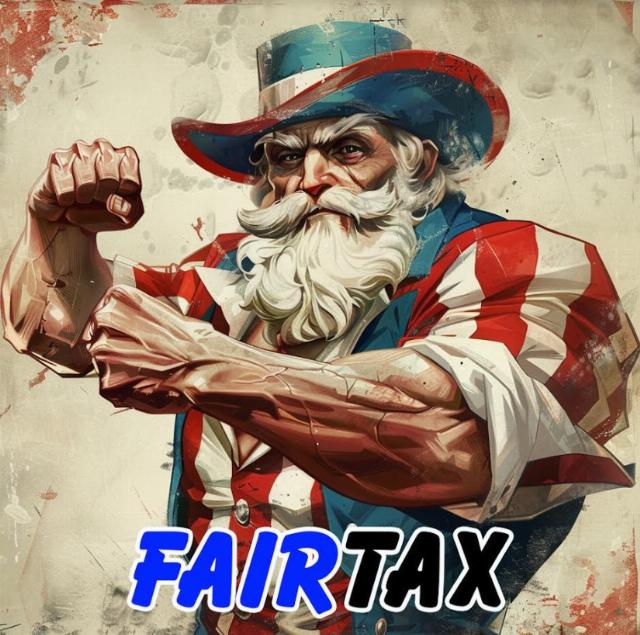
Basically, the FairTax replaces all federal taxes, including Income, Corporate, Social Security, and others. It replaces all of them with a single retail tax to raise a similar amount.

Here’s an example of how it works: Let’s assume it costs $1.00 for a loaf of bread. According to the people at FairTax.org, $.22 of that $1.00 represents the aggregated federal taxes paid by the baker, distributor, retailer, and every other entity who had a hand in putting that bread on the shelf, including the individual income taxes their employees pay. The bottom line, though, is that you’re paying $1.00 for a loaf of bread.

Under the FairTax, all those aggregated taxes would be eliminated. The loaf’s cost would then be $.78, which includes all the inputs and profits from the farmer, distributor, retailer, etc. At retail, the tax would be $0.23, making the bread’s price $1.01, which is almost the same as before.

But here’s the kicker: Under the current system, when you earn $1.00, you only have between $.63 and $.90 cents left after taxes with which to buy that bread. Under the FairTax, when you earn $1.00, you have $1.00 left after taxes. (You can find the extra penny between the couch cushions!)

Given that the bread’s price stays basically the same, one might ask, “What’s the point?” Well, there are many beyond that whole paycheck in your pocket.

1. Spur Investment in America:

America could use a real shot in the arm. GDP growth is miserable (currently 1.3%). “But at least it’s growing,” you say. Not really.

The government will print (borrow) $1.2 trillion this year to pump into the economy, which will likely come in at about $28 trillion. So, basically, the government is adding 4.2% to the economy via debt, which will have to be paid back, even as GDP grows by less than 1.5%! That’s not real growth. The FairTax would fix that. There’s no single thing Congress could do that would more effectively spur investment in the American economy.

The average corporate income tax around the world is 23%. By eliminating federal taxes, Congress would make America an investment magnet. Currently, the world invests $1.2 trillion across national borders annually, $400 billion of which comes here. (While immigrants send $800 billion out of the country annually.)

By dropping the income tax to zero, America would spur companies worldwide to prioritize investment in the United States and create millions of new jobs. At the same time, it would motivate American taxpayers to bring home most of the $4 trillion they hold offshore, as would US corporations that hold additional trillions of dollars outside the country. Both would spur investment and create jobs.

2. Spur Entrepreneurship:

American employment is driven by small businesses that are mostly owned by individuals who report their income on their personal tax forms. By eliminating federal taxes and allowing entrepreneurs to keep more of their money, the FairTax would spur more Americans to become entrepreneurs.

3. Increased Competition and Innovation:

As efficiency returns to the market and more entrepreneurs are motivated to start businesses, competition will increase, which leads to more innovation and lower prices. Consumers will not only keep more money in their pockets, as competition drives down prices, those same dollars will buy even more.

4. Limit Congresses’ Power:

Eliminating the Tax Code would remove Congress’s ability to use it to punish disfavored industries and reward pet projects. Lobbyists would inevitably lose much of their power, as a significant amount of lobbying is predicated on enticing Congress to write industry-favorable tax laws.

5. Collect Taxes from Underground Economy:

Everyone who shops would pay the FairTax, including those in the underground economy who currently pay little or no taxes, such as illegals, drug dealers, or employees who are paid in cash.

6. Eliminate the IRS:

Does this need any elaboration?

7. Spur investment and innovation:

By taking the yoke of the Tax Code and IRS off the neck of individuals and businesses, the FairTax spurs investment and innovation. That puts the United States on the strongest economic footing possible on an increasingly competitive global stage.

8. Gives people their time back:

The FairTax frees individuals and businesses to focus 100% of their attention on starting, running, and expanding their businesses rather than contemplating countless tax consequences for every move.

9. A Boost for the Poor:

The FairTax gives every household a “prebate“ equal to the tax a person living on the poverty line would pay. As a result, every family in America who’s living at the poverty level would essentially receive a 22% increase in their income.

The FairTax is not a panacea—just ask the WSJ. It won’t solve all of America’s problems, and it won’t balance the budget, rein in government spending, or eliminate the vagaries of the business cycle. Some employers may try to reduce wages, which will spur labor disputes.

Those issues pale, though, when compared to the FairTax’s greatest benefit: It will begin reining in the imperial federal government, thereby taking the first step in returning America to its true foundation. That foundation is an understanding that the primary function of government is to protect its citizens’ freedoms and allow them to pursue prosperity and happiness unfettered by the tyranny of an oppressive state. Such a resurrection of the 10th Amendment would by itself make the FairTax a worthwhile endeavor and, indeed, go a long way to Making America Great Again.

Thursday, December 14, 2017

Redux: What Christmas Reindeer Antlers Say About America

I rarely do this... OK, I never do this, but there's a first time for everything.  I'm going to recycle a post.  This one is from 2010, and the reason I'm reposting it is because of something painful I read last week saying: Study: American Kids Lack Entrepreneurial Spirit.  That's like a dagger to the heart to someone who knows a bit of history and understands that the American free market has driven more prosperity and pulled more people out of poverty than any system ever in human history.  The loss of American entrepreneurial spirit for the world would be like the sun running out of hydrogen.  It won't implode immediately, but for freedom and prosperity, the end is nigh.  Well, here's my pinprick of an attempt to maybe ignite a bit of entrepreneurial spirit in someone, somewhere... Some of the references may be dated (Like Groupon, which was a big deal back in 2010) but the point remains the valid.

One last note, for the budding entrepreneur out there or for the mature one, there may be no better present in the world than Harold Evan's "They Made America; From the Steam Engine to the Search Engine".  It's nothing short of brilliant.

What Christmas Reindeer Antlers Say About America

My wife is from France. In the four years we were on opposite sides of the ocean before we got married I had the good fortune to be able to visit the country a number of times. Much of that time I was working at Outback Steakhouse and always envisioned opening a unit in Paris. (I know, for most people that’s epicurean heresy, but consider the source… my favorite food is McDonalds and M&Ms…) Nonetheless, at Outback the fundamental idea was that we would prepare your food any way you wanted. You could have your salad dressing on the side, your Bloomin’ Onion cooked with flour, or you could have your steak extra well done. Whatever it was, we wanted you to be happy with your meal. When I mentioned the idea to my wife she said it would never fly because the idea of the customer being in charge of anything in France is largely unheard of, particularly as it relates to restaurants. Basically the rule is: Chef’s are trained to know what works with food so you basically get what they give you and you like it.

Not long after that I had another idea that equally befuddled her. Licensed apparel is a multi billion dollar business in the United States and around the world – think NY Yankee hats or Manchester United shirts. One of the biggest sectors of that industry here in the US is NCAA (college) licensed apparel. One day I suggested we think about going into the licensed apparel business and sell shirts, hats etc. for French colleges. She was puzzled. “Why would anyone want to buy a shirt with their college’s name on it?” I tried to explain the whole college rivalry, pride in your school deal to her and it just wasn’t clicking. She told me that such a business would likely not find a market in France because there is largely no such thing as school sports & spirit and French people would never understand the point. (The University of Paris tee shirts that are sold throughout the city are for tourists.) For the French, going to college is expected to be four years of focus and study with very little extracurricular activity of any sort, organized or otherwise. Simply put, it’s all work and very little fun and who wants to wear a shirt reminding them of that?

I thought about these two episodes recently when I saw a car with some reindeer antlers sticking up out of the door of a passing car. In a moment the subject of this column came to me: The beauty of America is the fact that anything and everything is possible here. When you peel back everything else, America is a place of possibilities. Americans by their very nature are a rebellious sort. From breaking with King George to Manifest Destiny to heading to the moon, America has always been a place where big things can and do happen. More importantly however, it’s also a place where everyday, seemingly inconsequential things can happen. What I mean by that is that it is not only the politician, the successful businessman or the wealthy heiress who can set out to pursue some grand design… it’s also the guy next door, the guy at the coffee shop or the guy you knew in 3rd grade who can do something that changes the world, or maybe just his little corner of it.

America is a place where people feel that if they can imagine it, they can make it come true. Although that doesn’t always lead to success, the aggregate impact of all that creativity on the country is tremendous. Think about how many things that you know of that are so fundamentally unimportant from the perspective of surviving in this world but impacted the lives of the people who invented them or used them. Silly Bandz. The Snuggie. College apparel. A dozen flavors of Coke. Personalized M&Ms. Car wrap advertising. Pet manicures. Cheesehead hats. QVC. Having it your way at Burger King. McMansions. The antlers are the perfect example. They’re utterly frivolous, but they let people express the fun side of Christmas and maybe make others smile as well. Not earth changing but certainly a net positive, particularly for whoever created and sells them.

The list goes on and on. And this is not an exercise in navel gazing. Just the opposite actually. It’s recognizing and appreciating the fact that America is a truly unique place and Americans are a unique people. Not because they any better or worse than anyone else, but because they have largely bought into the notion that in America anybody can have an idea and do something with it – although regrettably the system is increasingly suffocating the pervasiveness of that notion. Nonetheless, America has prospered – and much of the rest of the world has benefited – by Americans bounding forth from the darkness to invent things for which there was no demand, to do things that few might have thought possible or necessary and alas, to even stumble more often than not.

Many things that Americans come up with are indeed frivolous, but that’s really the beauty of the country. Just as failure is the foundation upon which success is built, a culture that tolerates and even extols the frivolous fertilizes the garden from which the consequential emerges. For example, while media giants have spent (and continue to spend) billions of dollars trying to figure out how to connect with Americans, something that started out as a way to meet and rate girls has actually accomplished it: Facebook. Yellow Page publishers have lost billions of dollars over the last five years because they can’t seem to figure out how to impact consumer behavior while a company built on the ashes of a website that helped people protest has managed to rapidly impact how and when millions of consumers spend their money: Groupon.

Whether it’s having your steak cooked exactly the way you want, sporting your schools’ mascot on the seat of your pants, or volunteering with Habitat for Humanity, America is more than anything a place where people feel like they are more than just cogs in a machine. They feel like they have the power to make their lives better and impact the world around them. Fundamentally, they are empowered to do things… frivolous or otherwise. That’s real freedom… the ability to decide what you want to make of your life and the opportunity to go out and do it, or even die trying. It’s not the destination that makes life worth living, it’s the journey. The journey in America may be cluttered with kitsch and failed ideas, but it is the dynamic energy fostered by freedom that has created so much of substance and so much abundance. As the year ends and politics takes a back seat to friends and family, we should remember and be thankful for that freedom which we so often take for granted.

Monday, June 6, 2016

Freedom & Fortune... The Spoiled American Voters of 2016 Squander Their Inheritance

In the segment of the financial planning industry that caters to the uber wealthy, the rule of thumb is that by the 2nd generation 70% of family fortunes are lost and by the 3rd 90% is gone. Why? “Most of them have no clue as to the value of money or how to handle it.” Financial wealth is not so different than freedom and Thomas Jefferson knew it: Eternal vigilance is the price of liberty.

The United States has thankfully lasted much longer than 3 generations, but the writing is on the wall and the election of 2016 is proof.

On one side of the debate we have Bernie Sanders and Hillary Clinton. We have two people who have zero experience in doing anything even remotely productive in the private sector in their lives. Bernie Sanders has virtually zero experience in the private sector as most of his many short lived jobs being for public or government institutions of one sort or another. His first steady paycheck not coming until he was 39 when he was elected Mayor of Burlington, VT. He’s never started a for profit company, he’s never ran a business that had to actually make a profit and meet a payroll… He’s never had to compete to attract consumers who are willing to freely exchange their hard earned money for a free market good or service he is providing. And, if it’s possible, Hillary Clinton has even less private sector experience.

Both of the people running for the presidency on the Democrat side have spent essentially their entire lives working in the public sector. As mayor. As congressional aide. As Congressman. As First Lady. As Senator. As Secretary of State. All of these jobs are funded by the taxpayers and in both cases their passions have been fueled by the desire to use the police power of government to bend the public to their will… in the service of good of course.

Donald Trump on the other hand has never had a job in the public sector. He’s been a builder and developer his whole life. He’s also been an operator of casinos, a reality TV show star, the leader of an eponymous university and he’s lent his name and likeness to countless products. While he parlayed his father’s $1 million loan and influence with bureaucrats into becoming a very successful real estate developer and reality TV star, the rest of his repertoire has been… shall we say, less than successful. But at the end of the day he’s a billionaire and that’s largely due to his real estate success. Not surprisingly, in that – real estate – Donald Trump has been in bed with government just as much as Bernie Sanders and Hillary Clinton. From using government tax handouts to finance buildings to using government sanctioned bankruptcy laws to threaten and blackmail erstwhile partners, Trump’s real estate success has been built on a foundation of government intervention… and everything else is built off of that. But at least he knows about meeting payroll and attracting customers who have a choice as to where to spend their money.

The fact that America has selected these three big government candidates as the only viable options for the White House tells you everything you need to know about America in 2016. Like the 2nd and 3rd generations of wealthy families, an overwhelming majority of Americans are more interested in what someone else – the government in this case – can do for them than what they can do for themselves. An overwhelming majority of Americans have no idea of what made America great in the first place. An overwhelming majority of Americans don’t understand exactly how close the nation is to killing the goose that laid our golden egg.

Half the population is prepared to vote for a socialist wannabe Hillary Clinton or the actual socialist Bernie Sanders. Their basic premise for governing is simply more regulation on businesses and individuals, more illegal immigration, higher taxes on the rich and more redistribution programs for the poor. Absolutely nothing in their positions suggests anything about helping businesses be successful. Nothing suggests freeing up capital or entrepreneurs to start the next big revolution. Nothing suggests driving down the cost of business so that companies can innovate, hire more employees and offer yet to be invented goods or services to the public. No, for Hillary Clinton and Bernie Sanders everything is about what the government can do for you or will do to someone else.

A significant portion of the remainder of the population are prepared to vote for Donald Trump, a crony capitalist of the highest order. The problem with crony capitalism is that it’s not really capitalism at all… it’s coercion of others by the state for the benefit of friends of bureaucrats and politicians. Whether it’s Vegas’s tax breaks for the billion dollar NFL or Georgia’s tax incentives for Hollywood movie production or the Agriculture Department’s subsidies of corn or sugar or peanuts, it’s all crony capitalism. So too is it when banking or broadcasting or healthcare regulation becomes so onerous that they stifle competition and innovation because only the ultra rich friends of government can afford to pay the compliance costs.

One way or another it’s always taxpayers, small businesses and average citizens who are left holding the bag for government decisions where bureaucrats and politicians put their personal or political agendas ahead of individual freedom and free markets. Fundamentally this is because so many Americans simply don’t understand that a government can’t produce prosperity, it can only stand in its way. That a government that can take something from someone else to give to you today can just as easily take from you to give to someone else tomorrow. That a government that can write rules that favor you today can turn around and write rules that handicap you tomorrow. One need look no farther than Cuba, Venezuela, Spain, France or Greece to see what such government strangulation of free markets and free citizens does. Economies that stagger from one crisis to the next. Widespread unemployment. Flatline economic growth or outright decline. Unrest in the streets. Such things are the hallmarks of big government.

And the truth is, supporters of the three contenders for the presidential crown have no clue how prosperity ever came to the United States in the first place. American prosperity dominated the world in the 20th century like perhaps no other nation has in all of human history. While China and India may have had a larger share of world GDP two millennia before, the 20th century saw world GDP grow more, and more broadly ever before, and growth was driven by the United States. More than anything else, that American Century was characterized by freedom where government – mostly – left free markets to solve problems and innovate a wider array of new products and services than the world had had ever seen.

Those times and that leadership are long gone and they may never return. Beginning with the trickle of the New Deal and picking up steam with the Great Society programs, government regulation and redistribution policies began to strangle the American economy by the end of the 1970s. It was on life support when Ronald Reagan was able to revive it with spectacular success. Since then however it’s largely been downhill. From George H.W. Bush to George Bush government regulation continued to grow year after year. Bill Clinton took advantage of the “Peace Dividend” to grow it more in between. Under Barack Obama government regulation and strangulation of the economy has advanced at an unprecedented rate. And the economy has shown it. During Ronald Reagan’s first 7 years the GDP grew at an average of 3.4%, during Clinton’s it was 3.84%, Bush’s 2.46% and under seven years of Barack Obama the American GDP has grown at a stultifying 1.4% a year… and this is during a period when $10 trillion was added to the National Debt and the Fed pumped in an additional $2 trillion! (BEA data in Excel)

And so it goes… like the wastrel children and grandchildren who blossom under fortunes built by someone else and proceed to lose those very fortunes, Americans have lost their way with prosperity and may not find it back. National prosperity demands freedom. Prosperity for the many demands free markets. Widespread prosperity demands limited governments. But rather than look for a president who will roll back the suffocating leviathan of government and unleash free markets and entrepreneurship, Americans are instead choosing to support candidates who offer to use the power of government to tilt the scales towards them and their friends at the expense of everyone else.

The sad thing is, it’s not like that choice doesn’t have a clear outcome. It’s been tried over and over again around the world and it always fails, every time. And it will fail here too. The question is, is a fiery collapse that resembles the likes of Venezuela in our future or is it the slow calcification of France or Greece where the government slowly strangles the citizenry to the point where practically nothing works and eventually the nation begins to simply implode? In either case as the consequences of the disastrous 2016 election begin to play themselves out over the next couple of years Americans should be prepared to find themselves involved in more wars, experiencing more economic failure, buckling under more government regulation and enjoying less freedom of all types, particularly speech. Add to that more racial division, riots, crime and ultimately, much more despair and distrust of the system. Such are the conditions of revolutions, the hot ones, not the ballot box types…

Monday, May 4, 2015

The War on Poverty - $40 Trillion Funding Failure Rather than Facebook or FUBU or Ford

Last year the United States celebrated the 50th anniversary of the War on Poverty begun by LBJ in 1964. Over that time the country has spent approximately $40 trillion on welfare and redistribution programs of one sort or another – and that number doesn’t include expenditures for Social Security or Medicare. The program started out slow, but has steadily picked up steam so that today the United States spends over a trillion dollars on welfare programs every year. To put that $1 trillion in perspective, that is more than the GDP of every country on the planet except for the 15 largest. It’s bigger than the GDP of Sweden, Saudi Arabia, Indonesia, Turkey, the Netherlands and around 175 others.

That’s a lot of money, but it must be worth it as the War on Poverty must have been a success… right? Not so much. Today poverty in the United States stands at approximately 15% of the population. Fifteen percent sounds relatively low, except when compared to the 18% rate it was $40 trillion dollars ago. After $40 trillion dollars and 50 years, the War on Poverty has reduced poverty by a staggering 3 percentage points!  What's worse, the War on Poverty actually stopped the progress that was already occurring:  During the 15 years prior to the beginning of the War on Poverty, the poverty rate in the United States had dropped from 30% to 15%!

Indeed, the single biggest accomplishment of the War on Poverty seems to have been the proliferation of single parent households… i.e. children born out of wedlock. In 1964 the percentage of American children born to unwed mothers was approximately 4%... so out of every 20 babies born, only 1 was born to an unwed mother. Today 8 out of every 20 babies born in the United States is born to an unwed mother. And according to studies by HHS and others, that’s largely because the welfare state has made such as choice feasible: Holding constant a wide range of variables, including income, education, and urban vs. suburban setting, the study found that a 50 percent increase in the value of AFDC and foodstamp payments led to a 43 percent increase in the number of out-of-wedlock births.

And the proliferation of unwed motherhood has resulted in a dramatic increase in crime, violent crime in particular. According to the Atlantic Magazine: “The relationship [between single-parent families and crime] is so strong that controlling for family configuration erases the relationship between race and crime and between low income and crime. This conclusion shows up time and again in the literature.” In 1965 there were 20 violent crimes for every 1000 Americans. By 2013 that number was 37. That doubling might not sound bad, until you realize that the incarceration rate in the US tripled over that same period, which means that as a percentage of the population there are three times as many Americans incarcerated today as there were when the War on Poverty began, but with many more criminals locked up the violent crime rate has still doubled.

So almost $1 trillion a year of welfare spending for half a century has basically made a small decrease in the poverty rate, pushed unwed motherhood through the stratosphere and dramatically increased the violent crime rate and prison population in the country. That sounds like a typical government success story.

Now let’s compare that to what a trillion dollars in one year might look like were in the private sector. Below are fifteen companies whose combined North American revenue was $1 trillion last year: Amazon, Apple, Coke, Disney, ExxonMobil, Facebook, Ford, General Electric, Google, J&J, JP Morgan, McDonalds, Microsoft, Nike, Walmart. So these companies with a combined $1 billion in revenue, what have they accomplished? Simply put, they have changed the world. Walmart has almost single handedly changed American retailing and driven inflation down everyone. Amazon redefined retail even further. Microsoft and Apple essentially created the computer revolution. McDonalds feeds the entire US population once a month. Facebook has connected a billion people around the world. Disney has entertained generations, ExxonMobil has fueled their journeys and Ford has built their cars and trucks.

Not only do these companies employ millions of people directly, but indirectly via their suppliers they drive the employment of tens of millions of others. So with a trillion dollars in revenue – money that was willingly exchanged for products and services – these companies have directly or indirectly generated an income for tens of millions of Americans who in turn support millions more family members. And they accomplished all of that while providing material benefits to the country as a whole.

One has to wonder what might have become of poverty had the $40 trillion the government siphoned out of the pockets of hard working Americans over the last half century had been left in their pockets. How many more of those children born to a single mother might have been born into a two parent household, gotten an education and gone on to start the next Disney or FUBU or UBER? How many more Spanx or Harpo Productions or Mary Kay Cosmetics were never founded because single mothers were sitting at home waiting for a welfare check rather than coming up with some revolutionary entrepreneurial moonshot? How many Under Armours or Facebooks or Chipotles never got founded because children grew up in poverty with no positive male role models around to help guide them? How much poverty would have been eliminated had each year’s trillion dollars gone into financing new startups rather than creating a dependency ecosystem?

At the end of the day the War on Poverty has been nothing short of a disaster. Not only has it sucked $40 trillion out of the hands of American workers and entrepreneurs, but it has also created an environment where tragic of circumstances have become the norm for tens of millions of Americans. More crime, more broken families and more broken dreams are the outcome of a half century of government failure. The tragedy is that this abject failure took place during one of the most economically dynamic periods in American history, and as a result of another failed government policy tens of millions of Americans found themselves stuck in the quicksand of government dependency and never had much of a shot at pursuing the American dream and seeing what potential greatness they might have brought to the world.

Saturday, February 7, 2015

From Silicon Valley with Love... and Hope for Free Markets

I’ve just returned home to Atlanta from spending a week in Silicon Valley at a program called Founder Institute. Basically FI is a bootcamp for founders of mostly tech startups. We were a pretty diverse group of companies. One wants to put servers in space, one wants to help golfers establish handicaps and another seeks to help equipment rental companies join the mobile revolution. Some had raised $3 million in funding, others were doing hundreds of thousands of dollars a month in revenue while the majority were like me and running on past savings or paychecks. We were also a pretty diverse group of people with participants coming from around the world. In addition from the US, attendees came from Croatia, Australia, the Netherlands, Canada, Columbia, Vietnam and Puerto Rico. Finally, we were of a variety of ages as well, ranging from early 20’s to mid 50’s... weighing more heavily to the latter.

My goal in going out was to get a better insight into what makes for a successful startup. I’ve been working on one startup or another for 15 years, but I’ve yet to achieve what I consider a really successful exit. In addition, I was looking for angel investors to fund my latest startup, BrandScanned, a mobile rewards app for consumers, based on brands. (Think about how much of a pain in the butt it is to collect soup labels or boxtops for the various programs that provide resources to schools. Wouldn’t it be easier if they just put a unique code on the inside of each package that you could scan with your phone and the school automatically gets the points? Or how about those contests Kelloggs runs for movie tickets or Frito Lay runs for an Xbox where you have to register on their websites and type in some ungodly long number that’s hidden inside the package. Same deal… wouldn’t it be easier to just scan the codes with your phone? I think so, which is why I founded BrandScanned.)
While I didn’t come away with an investment, I came away with some great insights. The first is something I’d been told before but never really got. Success in Silicon Valley – at least as it relates to raising angel and venture capital – is very much driven by relationships. It’s your network… investors want to get to know you… want to trust you… know that you’re resilient, creative and of course, smart. And it’s more than just a cup of coffee… although that’s where it often starts. Investors usually want to know that they are not alone and that you’ve got other investors in your network. And the key to your network is, unsurprisingly… you! As such, investors are often open to making introductions, but you’ve got to sell yourself because if you’re going to create a spectacular startup, if you’re going to make them lots of money, you’re likely going to need a lot of help in the form of employees, partners and other investors… and it’s up to you to engage and inspire them.

Another of the insights I came away with was that if you fail in Silicon Valley, that doesn’t mean you’re sunk. On the contrary. It appears to be the case that if you’ve failed, that’s almost a badge to be worn as you storm into your next endeavor having learned some lessons from your previous bruising. For every Facebook that pretty much gets it right from the beginning are dozens more like Twitter that took a circuitous route to success through failure. Failure is the fertilizer that nourishes and spurs creativity, which in can and often does blossom into success.

Finally, in Silicon Valley they love to think big. Big success followed by big exits are what investors live for. If you’re interested in starting a restaurant or building a business that will do a couple million dollars a year in revenue, good luck, but Silicon Valley investors are not likely going to help you do so… although they might become customers. They want businesses that have the potential to do $50 or $500 million a year in revenue so they can have exits that number in the eight or nine or ten figures. Since investors lose money on 9 out of 10 investments they make, they need to be able to earn enough back from one big exit to cover the cost of investing in the other nine and still make a profit. So don’t expect venture capitalists to give you the money to open pool installation business…

At the end of the day, my trip to Silicon Valley and participation in the Founder Institute program made for a great experience. But this wouldn’t be my blog if I didn’t tie that experience into the larger picture.

At a time when the government seems to be doing everything it can to undermine free markets, private property and capitalism in general, it’s good to know that the spark of enterprise still exists. That people feel like they can build something. That investors and entrepreneurs are foolhardy enough to think they can change the world. And willing to take a leap of faith to do so. And not only in the United States, which used to be a bastion of freedom, but in places where you might not expect it, like Vietnam, Croatia and Columbia. The question is however, once the long national nightmare of Barack Obama and his Democrat cleptocracy are finally on the ash-bin of history, can the spark of possibilities that still exists in Silicon Valley find its way back to places like Pittsburgh, Detroit, Chicago and the rest of California, where much of the spirit of opportunity and the American Dream seem to have been replaced by a populist economic fascism seeking to “fundamentally transform the United States”? Sadly, that the cancer of progressivism seems to have infected much of the country despite the fact that the American convergence of free markets and limited government have driven a greater advance in prosperity around the world any system in history. Nonetheless, perhaps the Silicon Valley mindset of unabashed opportunity is the canary in the coal mine that suggests the American Dream may still be alive, despite even the tech crowd’s distinctly liberal, big government leanings. Only time will tell.

Sunday, November 17, 2013

Of Startups and Meltdowns... Free Market Success vs. Government Failure

I’m an entrepreneur. I’m constantly full of ideas and trying to get businesses started. As I seek to launch my newest endeavor, BrandScanned, I’m trying to get myself involved in the Atlanta startup community. As such, last weekend I had something of a startup adventure. I participated in Startup Weekend at Georgia Tech, where people with ideas and skills get together in a mashup competition to build an idea into something more over the course 54 hours. Inexplicably, BrandScanned just missed attracting enough votes to be one of the projects that went forward, so I joined a team called Zuit. Zuit was the brainchild of a young woman named Megan, who saw an opportunity in the fact that women rarely feel beautiful or confident in off the rack suits. Her customized tailoring website idea was not only brilliant, but the team was amazing. Over the course of a weekend we took Megan’s idea and turned it into something more. The tech part of our team was made up of four coding geniuses, including these guys. They designed and built a beautiful demo website that was nothing short of spectacular.  My part of the team focused on the business model, the business opportunity and putting together the investor pitch while others filmed videos for the site.  

You can of course imagine the scene… Diet Cokes, granola bars, pizzas and lots of coffee. There were computers and iPads and mobile devices and lots of white boarding. Some of the teams had a plan then pivoted 180 degrees after talking to prospective customers. Others, including ours, stayed laser focused on the original idea. And that of course is the beauty of entrepreneurship, you combine what you’re good at or passionate about and figure out how those things fit with what customers need or want. 

While some of the ideas that teams worked on were throwaway and others were quite serious, the takeaway of the weekend was this: Driven people can do amazing things. Essentially a room full of people who mostly didn’t know one another were told to talk about their ideas, split into groups and then essentially “Go do something.” And they did. None of the ideas is likely to save the world or cure cancer, but that wasn’t the point. It was to try and make something. And they did.

The whole thing reminded me of something I’d read a few days before Startup Weekend. It had to do with three guys who developed HealthSherpa.com (an Obamacare clone that actually worked) in just a few days. Somehow, three 20 year old kids were able to build something in less than a week that the government couldn’t figure out how to accomplish in three years with half a billion dollars at their disposal. (Actually the government spent 4 times more building a broken website than apple did building the iPhone that changed the world.) What’s worse, the catastrophe that is Obamacare not only doesn’t do what was claimed it would do, but it actually makes matters far worse than it was on countless levels, and we’re not just talking about a dysfunctional website. Can you imagine if Apple built into the iPhone a tool that allowed convicted felons to track your whereabouts? Can you imagine if your stock broker took away your shares of Google and replaced them with shares of Zynga without asking? How about if you live in Iowa but in order to drive a car State Farm required you to have hurricane insurance? That's basically what the government does with Obamacare.

Thankfully the private sector doesn’t usually work that way. There are two reasons for that. The first is that in a free market consumers have choices, and they can vote with their feet and dollars when a company fails to meet their needs. With government that’s never the case. It decides what’s best for you and you’d better get used to it, because it’s pretty certain that you’re going to be stuck with it for a long time. There is no consequence for failure and as a result most government endeavors fail, miserably.

The second reason is that government operates from a top down mentality. A bunch of politicians, bureaucrats and lobbyists decide they know what’s good for you and then start writing laws and regulations and force you to comply. Unfortunately for you, while the ostensible motivation is your well being, in reality the driving force is usually the accumulation of power, money and of course reelection. Entrepreneurship is just the opposite. It’s a bottom up approach where most ideas come from people who are actually doing things and trying to find real solutions to problems in the marketplace or make their fortune by seizing opportunities where consumers are willing to pay for goods or services.

Which brings us back to Startup Weekend, Zuit and three guys behind HealthSherpa.com. Whether America wants real solutions to real problems or frivolous things that are… well, just fun, the source is unlikely to come from government. Genius ideas come about when creativity is fostered, success matters and the customer is the driving force. As Obamacare (which shares none of those things) decimates the American healthcare system it might be time for Americans to remember what created our unprecedented prosperity in the first place: free markets where entrepreneurs, inventors and innovators decided to try and do something and customers voted with their pocketbooks. As more of our resources are sucked into the abyss of government failure, less are available to invest in entrepreneurs like Megan who seek opportunities in building businesses that bring solutions to real problems. If the implosion of Obamacare does nothing else, maybe it will reverse that trend. Maybe that half billion dollars spent will have a positive outcome after all…

Monday, November 7, 2011

The Occupy Wall Streeters should put down their copies of Das Kapital and pick up this year's Forbes 400

Back in 2000 or 2001 I read a piece in Newsweek or TIME that discussed flyers whining that they didn’t have enough storage space in the overhead compartment bins on airplanes. I remember writing a letter to the editor saying that the only reason that people had the luxury of being able to whine about such things was that flying had become so safe that flyers could shift their focus to the more mundane. Then of course September 11th came along and people started focusing on the basic reason planes exist… to get them from point A to point B in one piece.

The Occupy Wall Streeters are just like the people whining about the overhead compartments. These are the people who enjoy the fruits of the capitalist system in which they live – iPhones, Starbucks, Facebook, Twitter, Twinkies, Nikes, ATMs, MSNBC, not to mention adequate food, shelter, and transportation, yet want to destroy that very system. They vote for economic dolts in the Democrat party like Barney Frank, Nancy Pelosi and Barack Obama and then blame capitalism when they screw it up.

Not only do they have no clarity about what they want, but they are wrong about most of those claims they are making. Bankers may be SOBs, but they didn’t cause the financial meltdown, Congress did. Their college loans are so heavy because government drove up college costs faster even than the rise in health care costs, not because of the 1%. The fact that with degrees in hand they can’t find jobs is because of government regulation and tax policy, not because of big corporations.

These people could benefit from putting down their copy of Das Kapital and ask their local banker for his copy of the Forbes 400.

The annual Forbes 400 issue lists the 400 richest people in the United States, the uber 1-percenters if you will. Just to make it on the list this year you had to have a net worth of slightly over $1 billion. Strangely, this list of the most hated of the really hated 1%, includes stars in the Democratic constellation like George Soros sitting at number 7 with a net worth of $22 billion and Mark Zuckerberg, Sergey Brin and Larry Page sitting at positions 14-16. Oh, and of course there’s also Mr. Solyndra, George Kaiser, at # 31 with $10 billion and President Clinton’s buddy, Ron Burkle, at 107 with his $3.2 billion.

When you hear the Occupiers talk about the 1%, it brings to mind a banker or industrialist sitting in his office gleefully writing pink slips just before Christmas so that he can improve the bottom line and buy another Gulfstream with his bonus money. Of course at the same time he’ll find some loopholes through which he can avoid paying any taxes on the bonus he earned for firing all of those workers. As he walks to the limousine that takes him to his Connecticut estate each night, he doesn’t even deign to make eye contact with the passing workers upon whose backs his fortune was made, at least the part that wasn’t left to him by his father and grandfather.

It’s of course possible that that caricature could be found amongst the people who make up the Forbes 400. That, however, is not the story of the list. What is the single most important thing about the list? The fact that 278 of them are self made. Think about that. While you’ll still find a Rockefeller and a Ford on the list, 70% of the richest of the rich in the United States are self made. That doesn’t mean that all of them were born into poverty like Oprah Winfrey or started selling shoes out of the trunk of their cars like Phil Knight, but 278 of the 400 started out in families that would never have made it anywhere near this list.

And the question is, how did those people make their money? Did they steal it from hard working Americans in some dark alley somewhere? No. Did they set up a high tech printing press and start forging bearer bonds? No. Did they use the police power of the state to jail competitors and take their money? No. Most of those people made their money the old fashioned American way, they earned it. They figured out how to provide a good or service to Americans and people around the world at a price they were willing to exchange their money for.

Obviously, if you listen to the Occupiers, all of those services must have been in banking, where the little guy has no alternative but to put their money in Wall Street banks. Not quite true. While 95 of the 400 made their fortunes in finance of one sort or another, there is a wide spectrum of other areas from which the fortunes came…

  • 17 made their money in manufacturing… like Jim David of New Balance Shoes, a company that manufactures 25% of their shoes in the United States.

  • 27 made their money in real estate… Like Bradley Hughes who built Public Storage into a $19 billion behemoth from a single self storage facility.

  • 30 made their money in food and beverage… like Truett Cathy, who started Chic-Fil-A with one restaurant after getting out of the Army in 1946.

  • 24 made their money in retail… like Bernie Marcus & Arthur Blank who started Home Depot (a company that employs 190,000 people) after getting fired for disagreeing with their boss at Handy Dan.

  • 40 made their money in energy… like Harold Hamm of Continental Resources who started off pumping gas and working on cars.

  • Then of course there are the 49 who made their money in technology… like Zuckerberg, Moskovitz and Saverin of Facebook or Scott Cook who created Quicken after his wife complained about balancing the checkbook.

The members of the Forbes 400 made their fortunes by giving consumers, businesses and governments goods or services they were willing, if not happy, to pay for. They delivered food to stores and pizza to homes, they made shoes, software and toys, they built roads, bridges and buildings, and they entertained with movies, music and video games. And the funny thing about those 400 people is that they are only a fraction of the entrepreneurs and businesspeople in the United States who are providing those services. There are 22 million small businesses in the United States headed by people who are trying to become successful enough to make that exclusive club, and virtually every one of them understands that the way to get there is to provide customers with sufficient value to convince them to willingly exchange their hard earned dollars for their particular good or service.

The existence of guys like Bernie Madoff, Dennis Kozlowski or Kenneth Lay in no way diminishes the benefits that Americans (and people around the world) have enjoyed as a result of the efforts of the people in the Forbes 400 or the hated 1%. They may have been thieves and con artists, but none of them did a fraction of the damage done by Franklin Raines, Jamie Gorelick or Chris Dodd.

The question of the day is, would you rather have unaccountable bureaucrats and politicians using the police power of the government to decide the fate of the economy or would you rather let companies and entrepreneurs compete for your interest and money in a free market? While the Occupiers and their union and Democrat comrades would prefer the former, I'd take the latter 10 times out of 10. Things might not work perfectly, but they’d certainly work far better than if they were run by government apparatchiks.

Monday, October 24, 2011

Legacy: Was Steve Jobs a selfish son of a bitch?

Steve Jobs passed away earlier this month with an estimated fortune of $8 billion. I have yet to see a single report about one single dollar that he gave away to charity. How is it possible that a person who was lucky enough to be born and grow up in the United States and take advantage of our laws, schools, infrastructure and patent protections could be so selfish? Compare his lack of philanthropic giving with that of other similarly rich types, past and present. Andrew Carnegie gave away virtually his entire fortune, over $350 million dollars during his lifetime – $5 billion in today’s dollars. John D. Rockefeller gave away over half a billion dollars over his lifetime – $8 billion in today’s dollars. Bill Gates has given away over $30 billion dollars and promised to give away most of the rest of his fortune while his friend Warren Buffett has promised to donate 99% of his wealth. The pair has created The Giving Pledge where billionaires pledge to donate a significant amount of their fortunes to charity. If all of these people can give this amount away, what was wrong with Jobs?

Charity and private giving has been a great force in America since its founding. Through churches and local organizations for those of modest means to building libraries, museums, or foundations for the wealthy, America has been a country where the successful and struggling alike look to support their communities as well as support the less fortunate around the world.

Apparently not so for Steve Jobs however… and charity’s not the only place he was tight. When he was alive he did everything he could to reduce his taxes. He used tax shelters to lower his tax rate from 35% to around 15% on millions. He put his real estate and other assets in trusts so they would escape the death tax.

Everywhere you look Steve Jobs was doing what he could to keep his own money. Not giving it away. Avoiding paying taxes. All while he’s taking advantage of everything America has to offer.

What’s wrong with a person who sees the misery going on around the world, from hunger in Africa to millions of poor here and does nothing to lend a hand? What kind of legacy is that?

When the robber baron Andrew Carnegie died his legacy was obvious. He had built thousands of libraries around the world, founded a university and built Carnegie Hall. By the time he died, JD Rockefeller had remade the face of modern medicine and created what was for years the largest charitable foundation in the world. Bill Gates is still very much alive, and he is remaking the face of charity. What kind of legacy is Steve Jobs leaving?

In 1977 he and Steve Wozniak introduced the Apple II, the first fully assembled personal computer. At the time the notion of a personal computer was an utterly foreign concept to 99.9% of the people on the planet. Term papers were still being written on typewriters. Math was still being done on calculators. Research was still done at the library.

In 1984 Apple introduced the Mac, the first personal computer to feature a mouse and graphic user interface. At the time most others still used the C: prompt.

In 1986 when he purchased Pixar, it was primarily a high-end computer hardware company with graphics as a side note.

In 2001 when Apple introduced the iPod, digital music was just becoming popular but most digital players were “big and clunky or small and useless”.

In 2003 when Apple introduced the iTunes Store the music industry was imploding and college students were being sued in their dorms.

In 2007 when Apple introduced the iPhone few people were able to surf the Internet on their phone and most competitors’ products were poorly designed and performed similarly.

In 2010 when Apple introduced the iPad, it essentially created the market, selling 5 times more than the rest of the devices combined.

Looking at all of this, the question to ask is, is Steve Job’s legacy going to be that he didn’t care about other people because he didn’t give his money away or let the government take it? Or is it going to be the fact that he changed the world and gave people something that is far more precious than money… more of their own time.

If you didn’t have a computer, how many hours a day would you have to spend (or would you have spent) in front of a typewriter typing, retyping or whiting out errors as you wrote a paper for class? Or doing computations with paper, pencil and a TI calculator? How much less efficient would your job be? Steve Jobs began and led the march that made the personal computer such an integral part of our lives, both personally and professionally. The value of that contribution to the improvement in the human condition is measured in the tens of trillions of hours and dollars rather than millions or billions. Add to that the value of the entertainment provided by iTunes & Pixar and the efficiency provided by the combination of mobility & functionality embodied in the iPhone and iPad and there are hundreds of billions more hours and dollars.

I never met Steve Jobs and from what I read he could be both generous and an SOB to those who knew or worked for him. Regardless of his personality or lack of a philanthropic gene, the fact of the matter is that he did far more for the world by running his business – and keeping the money generated from doing so – than he ever could have if he had “given back” every penny he ever earned or let the government tax him at the highest possible rate.

What might have become of Steve Jobs if today’s kleptocracy and regulatory straitjacket had kept him from starting his business in his parent’s garage with $1,200? Given that his return to Apple was driven by stock options and performance incentives, would he have returned if the “Occupy Wall Street” types had been setting tax policy? Or would he have decided to retire and travel the world?

We can’t know the answer, but we do know is that Steve Jobs created far more value for the world than he received in return. If he wanted to keep every single penny of it the world was still far better off. That’s how private enterprise works. It’s an exchange of ideas or products or services that others are willing to pay money for. In the end, although successful entrepreneurs and businessmen may indeed earn millions or billions, in almost all cases they do so by having provided customers or clients many times that in value. If you think Jobs was the only one, think about how much YouTube and Facebook have changed your life over the last five years. The founders of both are billionaires but the value of the benefits to the millions of ordinary citizens is many times that.

If the people at OWS or in the kleptomaniac ridden Democratic Party really wanted to jumpstart the economy and drive prosperity all they need to do is look at Steve Job’s life and give as many people as possible the opportunity to follow his path. Reduce taxes and regulations and just watch and see how many would-be Steve Jobs types come out of the woodwork.

Selfish son of a bitch? Don't know. Doesn't matter. A model for prosperity and improving the human condition… now that’s a legacy worth leaving.

Monday, March 14, 2011

The rich don't pay their fair share... unfortunately that's true.

There’s an old saying; A picture is worth a thousand words. Pie charts will likely never be confused with great art in terms of story telling, but they have a way of making complicated issues clear. Income taxes are one of those things that are naturally difficult to grasp and the issue is made that much more opaque because liberals love to obscure the facts.

One of the shibboleths of the left is that the rich don’t pay their fair share of taxes. One of the more amusing segments of the 2008 Presidential campaign involved Neal Boortz asking then Democrat hopeful Dennis Kucinich two simple questions:
  1. What percentage of total income is earned by the top 1% of income earners?

  2. What percentage of total federal income taxes are paid by the top 1% of income earners.

Congressman Kucinich answered: He thought the top 1% of income earners earned 60% of the income and paid about 15% of the taxes. He was a little off. In fact, the top 1% of income earners earn approximately 17% of all the earnings in the country. That’s certainly higher than the 1% they represent of the population but a far cry from Congressman Kucinich’s 60%. More astounding however, is that they pay fully 39% of all of the federal income taxes - according to a 2009 Congressional Budget Office report. The below chart demonstrates clearly the absurdity of the notion that the rich do not pay their fair share of taxes.

The first chart shows that the rich do indeed pay far more than their oft cited “fair share” of income taxes. Not only that, it also shows that the bottom 40% of wage earners actually have a negative tax rate and get money back from the government in the form of income tax credits!

Another of the left’s arguments is that the lower income wage earners pay a disproportionate amount of the Social Security / Medicare tax. That too is false. The second chart states that the top 10% of wage earners pay 43.5% of all social insurance taxes while the bottom 40% pay just 15%.

Why does any of this matter in the first place? The third chart (taken from a 2010 report from the Tax Foundation) demonstrates why…Jobs. It compares wage & salary, capital gain, and dividend income for all income earners. As you can see, for the 80% of income earners below $200,000 per year, wages (i.e. a job) make up almost their entire incomes. Without jobs that someone else creates they would have no income... except government transfer payments.

At the $200,000 and above level, business and dividend income starts to take off and by the $1,000,000 and above level the three are almost equivalent. Those are the telltale signs of success. Those people earning those $200,000 and above incomes are the people creating the jobs that employ most of the remaining 80% of the population.

Put another way, jobs are not created by wage earners. Jobs are created by entrepreneurs risking their capital to start businesses… And those entrepreneurs are the usually found in that $200,000 and above group. The businesses they start generate 65% of all new jobs created in the United States.

While the first two charts debunk the myth that the rich do not pay their “fair share” the above chart demonstrates why it matters: The rich are the ones starting small businesses and creating jobs and prosperity.

Myths die hard, particularly when their proponents willingly ignore the facts. The myth that the rich don’t pay their fair share should soon be headed the way of the global warming hoax. Clearly it is the people at the upper end of the income spectrum that are being treated unfairly. They are not paying their fair share... They are paying more. Not only are they responsible for 2/3 of all new jobs created, but in return they are rewarded with being allowed to keep even less of their income as they become more successful. Perhaps as more Americans examine and understand what it takes to generate and sustain a dynamic and growing economy the “tax the rich” cries will begin to fall on deaf ears. That’s exactly what America could use right now, a reinvigorated entrepreneurial class striving to put more money in their pockets… and generating millions of jobs in the process.