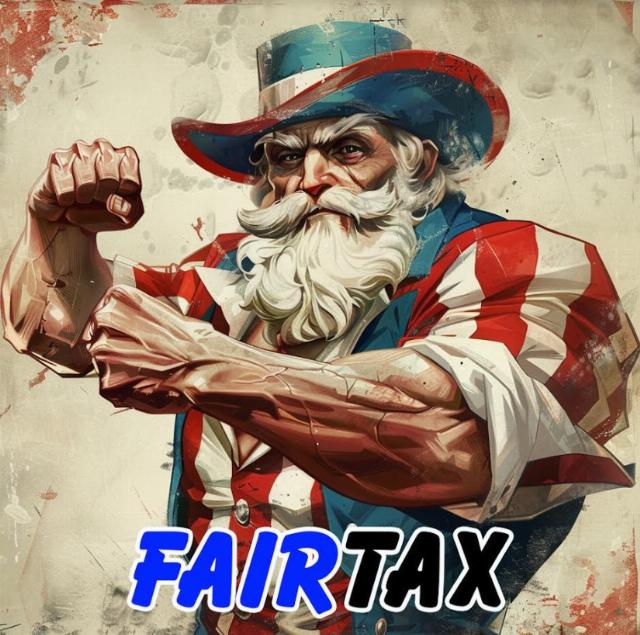
Showing posts with label Fair Tax. Show all posts

Monday, August 18, 2025

An 18th Century Scottish Historian Foretells 21st Century America

Our Constitution, perhaps the greatest document in human history behind the Bible, is not quite perfect. In 2025 we can see things that might have been added. Number one is probably term limits.  Another would be a prohibition on deficit spending outside of war.  And maybe they could have added something about judges being responsible for the crimes the criminals they release into society commit…

No doubt there are countless things we could sit here 250 years later and think of that the Founding Fathers could have added but didn’t because they couldn’t see into the future. One thing they could see clearly was that the nature of man is to accumulate power, use that power to take from others and that the most effective way of doing both is by harnessing the power of government. 

Alas, it wasn’t possible to put frameworks in place to control all of the base instincts of men as they are simply unending and evolve constantly. The Founders could not envision our world.  They could write about freedom of speech and the press, but they couldn’t have known about radio or mobile phones or the dark web or Bitcoin or shadowbanning. 

Nonetheless one of the greatest attributes of their Constitution was its staggered terms. The House, the place from which spending originates, is the closest to the people and is elected every two years. The President, who executes the laws, has a term of four years.  Then the Senate, originally the representatives of the state legislatures, serve staggered six-year terms.

The goal of these staggered terms was to tamp the passions of men such that if a majority wanted something they couldn’t easily command it and it would take years for them to take control over the government. The Founders understood that tempers run hot but cooler heads often prevail with time and therefore they wrote a document with built in cooling off periods.

What the Founding Fathers never envisioned however was a permanent government, in either the elected officials or the bureaucracy.  Sadly, today we have both. That wouldn’t be a significant problem if government was as small as it was initially.  Indeed, for America’s first 50 years we had a Department of State, Treasury, War, Attorney General and Postmaster General.  That was it.  Interior and Agriculture came in the middle of the 19th century when the country was adding states and territories rapidly and farming was becoming a major point of conflict between cattle herders, sheep herders, farmers and miners, not to mention Indians.  Nothing more until the Department of Commerce and Labor in 1903 – the two split in 1913.

The point is, for most of the first half of America’s history the federal government was essentially an afterthought in the minds of most Americans.  For the Founding Fathers government was part time.  Today it’s anything but. To put this in perspective, there have been almost 2,000 people who have served as a US Senator, and of the 25 who served the longest, all but one started his career in the 20th century – 15 of them after 1960 – and two are still there!  Similarly, over in the House, where 12,000 people have served as Representatives, of the 33 longest serving, all but one began their service in the 20th century and four are current members.  The Founding Fathers didn’t see a need for term limits because for them Congress was a service to the country, not a job, and certainly not a permanent career.

Today the federal government is anything but an afterthought in the lives of Americans. Not only does it seek to control almost every aspect of our lives, but it spends like a drunken sailor on liberty weekend.  Not surprisingly, most of the regulations that stifle productivity and innovation and the departments from which most spending emerges are those created in the last century. Seventy five percent of the federal government spending is on things that simply exist at the federal level for our first 150 years.  From healthcare spending to food stamps to Social Security to education, the limited government our Founding Fathers left us with has metastasized into a borg that grows year after year, regardless of who’s in control. 

This does not end well, particularly as the United States is $37 trillion in debt, with twice that in unfunded obligations.  The words of Scottish historian Alexander Fraser Tytler explains why:  “A democracy will continue to exist up until the time that voters discover that they can vote themselves generous gifts from the public treasury. From that moment on, the majority always votes for the candidates who promise the most benefits from the public treasury, with the result that every democracy will finally collapse due to loose fiscal policy, which is always followed by a dictatorship.”

On our present course, that is America’s fate. Sadly we have few leaders willing to tell Americans the truth about that reality.  While we have men like Rand Paul and Thomas Massie, Americans writ large don’t seem to be interested in following them. 

There are solutions however.  The FairTax would be a giant step in the right direction as it would remove from politician’s hands the ability to manipulate the tax code to give donors goodies. We could sunset regulations.  As an example, every law on the books would sunset after 10 years unless it was renewed by Congress, and would face sunset every 10 years unless it was passed by 60% of each house. Then there’s zero based budgeting, where every department must justify its entire budget from scratch every two years.  At the same time, welfare and other wealth redistribution programs that were never part of the Constitution in the first place must be eliminated, perhaps phased out over a four year period.  And of course, not to be forgotten… term limits.

Implementing these steps would rein in government spending and regulation, but more importantly they would simultaneously unleash an economic juggernaut unlike anything the world has ever seen. 

But as Tytler suggested, that’s not how things usually work. In 1776 a group of extraordinary men risked their lives and livelihoods to give free men an opportunity to build a new nation based on individual liberty and limited government. But before they could do that they needed to inspire the colonies’ citizens, two thirds of whom either wanted to remain British or were undecided.  Against all odds they not only inspired a nation but led it to victory against the world’s most powerful empire. 

But then they did something even more amazing.  Building on the Declaration of Independence’s recognition that rights come from God, they wrote the world’s first constitution based on those individual rights and framed a limited government to allow men to exercise them. 

Today America needs a new group of would-be heroes, men willing to target the entrenched barnacles that have grown up around our Constitution and the leeches that feed off both. It will take wordsmiths like Payne and Jefferson, coalition builders like Madison and Marshall and a leader like Washington to have any chance at success. Let’s hope they emerge before Tytler’s warning comes true. 

Tuesday, July 16, 2024

FairTax 101: Making America Great Again

President Trump recently floated the idea of eliminating the federal income tax. That tax became a fixture in 1913 when Congress ratified the 16th Amendment. The first U.S. Tax Code was about 400 pages. Today, with everything included, it’s more than 70,000 pages! Initially, the income tax was 1% on all incomes above $3,000 ($95,000 in today’s dollars) and applied to only 3% of the population. Today, the graduated rates start at 10% for families earning more than $30,000 and go up to 37% for families earning above $609,000. The rates vary greatly: The top 1% of taxpayers pay 45% of all income taxes, the top 25% pay 89%, and the bottom 47% pay 0%.

Trump understands that the tax system is a yoke on the neck of American prosperity. According to the National Taxpayer’s Union, Americans spend approximately $260 billion a year complying with the federal Tax Code, most of which goes into the pockets of accountants and lawyers. And that doesn’t count the countless billions businesses spend adjusting their operations to reduce their tax burden in the first place.

Trump has floated the idea of replacing the income tax with tariffs on imports. That’s neither feasible nor a great idea, but the notion of scrapping the current system is a compelling one, particularly if it eliminates the IRS. There’s a great (albeit not perfect) replacement for our current system, one that would replace the current dysfunction and replace it with something that would give the American economy a much-needed jolt: The FairTax.

Basically, the FairTax replaces all federal taxes, including Income, Corporate, Social Security, and others. It replaces all of them with a single retail tax to raise a similar amount.

Here’s an example of how it works: Let’s assume it costs $1.00 for a loaf of bread. According to the people at FairTax.org, $.22 of that $1.00 represents the aggregated federal taxes paid by the baker, distributor, retailer, and every other entity who had a hand in putting that bread on the shelf, including the individual income taxes their employees pay. The bottom line, though, is that you’re paying $1.00 for a loaf of bread.

Under the FairTax, all those aggregated taxes would be eliminated. The loaf’s cost would then be $.78, which includes all the inputs and profits from the farmer, distributor, retailer, etc. At retail, the tax would be $0.23, making the bread’s price $1.01, which is almost the same as before.

But here’s the kicker: Under the current system, when you earn $1.00, you only have between $.63 and $.90 cents left after taxes with which to buy that bread. Under the FairTax, when you earn $1.00, you have $1.00 left after taxes. (You can find the extra penny between the couch cushions!)

Given that the bread’s price stays basically the same, one might ask, “What’s the point?” Well, there are many beyond that whole paycheck in your pocket.

1. Spur Investment in America:

America could use a real shot in the arm. GDP growth is miserable (currently 1.3%). “But at least it’s growing,” you say. Not really.

The government will print (borrow) $1.2 trillion this year to pump into the economy, which will likely come in at about $28 trillion. So, basically, the government is adding 4.2% to the economy via debt, which will have to be paid back, even as GDP grows by less than 1.5%! That’s not real growth. The FairTax would fix that. There’s no single thing Congress could do that would more effectively spur investment in the American economy.

The average corporate income tax around the world is 23%. By eliminating federal taxes, Congress would make America an investment magnet. Currently, the world invests $1.2 trillion across national borders annually, $400 billion of which comes here. (While immigrants send $800 billion out of the country annually.)

By dropping the income tax to zero, America would spur companies worldwide to prioritize investment in the United States and create millions of new jobs. At the same time, it would motivate American taxpayers to bring home most of the $4 trillion they hold offshore, as would US corporations that hold additional trillions of dollars outside the country. Both would spur investment and create jobs.

2. Spur Entrepreneurship:

American employment is driven by small businesses that are mostly owned by individuals who report their income on their personal tax forms. By eliminating federal taxes and allowing entrepreneurs to keep more of their money, the FairTax would spur more Americans to become entrepreneurs.

3. Increased Competition and Innovation:

As efficiency returns to the market and more entrepreneurs are motivated to start businesses, competition will increase, which leads to more innovation and lower prices. Consumers will not only keep more money in their pockets, as competition drives down prices, those same dollars will buy even more.

4. Limit Congresses’ Power:

Eliminating the Tax Code would remove Congress’s ability to use it to punish disfavored industries and reward pet projects. Lobbyists would inevitably lose much of their power, as a significant amount of lobbying is predicated on enticing Congress to write industry-favorable tax laws.

5. Collect Taxes from Underground Economy:

Everyone who shops would pay the FairTax, including those in the underground economy who currently pay little or no taxes, such as illegals, drug dealers, or employees who are paid in cash.

6. Eliminate the IRS:

Does this need any elaboration?

7. Spur investment and innovation:

By taking the yoke of the Tax Code and IRS off the neck of individuals and businesses, the FairTax spurs investment and innovation. That puts the United States on the strongest economic footing possible on an increasingly competitive global stage.

8. Gives people their time back:

The FairTax frees individuals and businesses to focus 100% of their attention on starting, running, and expanding their businesses rather than contemplating countless tax consequences for every move.

9. A Boost for the Poor:

The FairTax gives every household a “prebate“ equal to the tax a person living on the poverty line would pay. As a result, every family in America who’s living at the poverty level would essentially receive a 22% increase in their income.

The FairTax is not a panacea—just ask the WSJ. It won’t solve all of America’s problems, and it won’t balance the budget, rein in government spending, or eliminate the vagaries of the business cycle. Some employers may try to reduce wages, which will spur labor disputes.

Those issues pale, though, when compared to the FairTax’s greatest benefit: It will begin reining in the imperial federal government, thereby taking the first step in returning America to its true foundation. That foundation is an understanding that the primary function of government is to protect its citizens’ freedoms and allow them to pursue prosperity and happiness unfettered by the tyranny of an oppressive state. Such a resurrection of the 10th Amendment would by itself make the FairTax a worthwhile endeavor and, indeed, go a long way to Making America Great Again.

Sunday, May 1, 2016

Ted Cruz's Only Hope for Indiana and Beyond: "The Government didn't build the American Dream..."

This has been a tough week for Ted Cruz. He lost 5 states by double digits. Of course they were all northeastern states which means there’s a snowball’s chance in Hell that they will be landing in the red column in November. Nonetheless Trump won them fair and square and he appears to have momentum.

So now there’s Indiana. The numbers are such that if Cruz does not win Indiana, it becomes almost impossible for him to stop Trump from getting to 1237. Given the glowing coverage that Trump gets from the mainstream media, as well as his cheerleaders in the erstwhile conservative media such as Drudge, Rush, and Hannity, Cruz finds himself very much fighting an uphill battle.

He can’t outTrump Trump. He can’t accuse Trump of lying – despite the fact that he is. He can’t accuse Trump of seeking to intimidate delegates – which he is doing. He can’t make nonsensical appeals to uninformed voters’ base instincts – because that’s not who he (Cruz) is. No, the only chance Ted Cruz has to win Indiana – and California beyond that – is to make his pitch for the American Dream.

Basically, it's that Dream that is behind so many voters flocking to Trump in the first place… that along with our celebrity worship culture where many elevate celebrities to a demigod state, regardless of their less than godlike behavior. Americans are angry that opportunities for advancement are disappearing. Americans are angry that every widget found in Wal-Mart is manufactured in China and every tee shirt in Pakistan. Americans are angry that an American icon, Ford, would reduce production here just to add production in Mexico. And Indianans are angry that Carrier would close a plant in Indiana just to open one in Mexico. The bottom line is, many Americans wonder what happened to a country where hard work and innovation were rewarded and where half the population was not on welfare of one sort of another.

One guy seems to be harnessing their anger and making it so they don’t feel like no one is listening… and that guy is Donald Trump. Ted Cruz needs to jump into the scrum. Ted Cruz needs to be crystal clear that he understands what they are feeling… but he shouldn’t pander while doing so… or he’ll be seen like Hillary trying to use an MTA card. No, Cruz has to talk about their issues, but do so in the context of what is causing them. Manufacturing is indeed moving the Mexico and China… but it’s not because companies like Ford and Carrier hate Americans… it’s because the government has made it so difficult for them to operate and earn a profit in the United States. And it’s not just labor costs, because Ford could have saved half its labor costs simply building the Focus in Alabama or Kentucky rather than Michigan. No, the much bigger problem for companies trying to manufacture and keep jobs in the United States is regulation.

Ted Cruz needs to point out that it’s not malice that encourages American companies to build products outside our borders… it’s government. Federal regulation costs the US $2 trillion a year… Looked at in jobs, just half that total would translate to 10 million new jobs at an average salary of $75,000 each. Unfortunately, this regulatory burden not only makes it more difficult for American companies to build here, it scares off international companies who might otherwise invest in the United States. Fundamentally, if the government would loosen the regulatory yoke and unleash American industry, our economy would once again dominate the world.

And then there is the IRS. Because at 40%, the United States has the highest corporate income tax rate in the developed world, companies find it less competitive to invest in the United States. Not only that, American companies have $2 trillion in profits sitting in subsidiaries around the world that they can’t bring home because it would cost them too much in taxes. That $2 trillion alone would provide 2 years of paychecks for 15 million Americans at $50,000 a year. By eliminating the IRS and implementing the Fair Tax – which Cruz likes but doesn’t push – a President Cruz would welcome trillions of dollars of investment in the United States from around the world.  Cruz's 10% income tax would have a similar, albeit a somewhat smaller impact.

At the end of the day, the only chance Cruz has to win Indiana and keep Trump from becoming the nominee is to clearly and forcefully articulate that the enemy of prosperity is not Carrier moving a plant to Mexico or Burger King moving its headquarters to Canada… it’s government strangling the American Dream one regulation at a time, it’s tax rates that handicap the country relative to the rest of the world. And in setting up that argument, he has to highlight the fact that Donald Trump’s solution of trying to tax Carrier back into the country is not the answer because for every Carrier that makes the news, there are hundreds of other companies around the world that aren’t located here and never will be because taxes and regulations simply make it too expensive to invest in the United States and create American jobs.

Donald Trump wants to scare companies into staying in the United States and employing Americans. Ted Cruz wants to inspire companies, both American and foreign, to invest in the United States and employ American workers. That’s a big difference and Cruz has to make that clear to voters. Trump wants to use the government to coerce companies to do what he wants while Cruz wants to lighten the government burden and allow American companies and American workers do what they do best, which is innovate and build their way to prosperity. The government did not invent the air conditioner, Willis Carrier did. The government did not bring the assembly line to the automobile, Henry Ford did. But government regulations have sent the companies those two men founded scurrying south of the border to build products in their names.  That is the shame of America in 2016... America used to be a place for entrepreneurship, innovation, invention and most of all, prosperity.  It's not today because of government.  The American Dream used to inspire both Americans and the rest of the world.  It doesn't do that much today because the government has smothered it...

And that's the message Cruz needs to get out:  "The government needs to get out of the prosperity killing business and out of the dream killing business... I understand that and I'll make it happen... Lifelong crony capitalist and John Boehner's golfing and texting buddy Donald Trump won't." 

Monday, October 13, 2014

A solution for American economic malaise - Detroit as a proving ground for economic prosperity.

The United States is in the midst of an economic malaise. 92 million Americans are out of work. 35% of the population is on welfare. The economy is barely growing. While incomes for the richest have been skyrocketing, the middle class has seen their incomes decline by 5% in the last 5 years. The federal debt stands at $17 trillion, up $6 trillion since Barack Obama became president. All of this while the Fed has been pumping tens of billions of dollars a month into the economy for years…

Although Barack Obama has made much of this worse, the truth is, things have been going the wrong way for half a century and rather dramatically for a quarter century. Of all of the problems that exist today – and their numbers are legion – there are two that are most troublesome: regulations and taxes. These two things have hammered the fount of American prosperity, the middle class.

First is the regulatory state – particularly federal regulations. Being an entrepreneur, running a successful small business (from whence 2/3 of all new jobs emerge) takes a great deal of work, tenacity and effort. Unfortunately however, the cost of complying with regulations has skyrocketed over the last 40 years. From the EPA to OSHA to the NLRB to HHS and a seemingly endless array of acronymmed bureaucracies come regulations that strangle job creation, and in the process, prosperity. According to the US Chamber of Commerce – no friend to small business – the cost of complying with government regulations at all levels has almost quadrupled since 2000… and all of those increasing costs contribute to the growing death rate among small businesses, which in turn take jobs with them.

Then there are taxes, again, particularly federal taxes and the insane complexity of the IRS tax code. This can be summed up in one measure: According to the Tax Foundation’s 2014 International Tax Competitiveness Index the United States ranks 32 out of 34 developed countries in terms of the competitiveness of our tax system – and if it weren’t for our relatively low consumption taxes, ranked 5 out of 34, we’d be dead last. That means, for companies seeking to invest their money, of the 34 OECD nations, only 2 of them have tax structures that are less inviting than the United States, Portugal and France. Imagine that, that the United States tax system is less attractive to investors – and prospective employers – than Turkey, Estonia, Chile… and even the dysfunctional Greece! While the United States does have advantages… for investors, tax consequences are an extraordinary driver of their choices. And unfortunately for American workers, the government is making the choice to invest in the United States less and less appealing every year.

Despite what you might hear on the Sunday morning news programs or read in the NY Times, this new American malaise is not an intractable problem, is not an unsolvable problem, in fact, the solution is rather simple. Fix those two problems. “How?” you say.

First, sunset every federal regulation on the books. If necessary, pass a Constitutional Amendment that states that every federal law has an implicit sunset provision of 10 years unless it passes each house of Congress by at least 60%. It would also stipulate that all federal regulations sunset after 10 years, regardless of the margin of passage of the underlying law. If such regulations demonstrate themselves to be effective and necessary, they can be renewed. If a regulation were deemed or proven to be sufficiently important to be granted permanent status it should then be passed as a law rather than remaining a regulation.

Second, implement the Fair Tax – although a 10% flat tax might be a distant second suggestion. In 2014 investors have the world at their fingertips. Choices abound from Estonia to Singapore to Switzerland to Canada. If the United States were to implement the Fair Tax, not only would the economy be jolted by an immediate influx of an estimated $2 trillion from the offshore holdings of American companies, it would likely experience an additional annual influx of hundreds of billions of dollars of direct investment from foreign companies seeking to set up shop in the United States. Those additional trillions of dollars would result in the creation of millions of jobs – and these would be real jobs in the real economy, unlike the boondoggles inflicted on the country by President Obama’s “Stimulus”. In addition, the resulting savings of the hundreds of billions of dollars wasted each year simply trying to comply with the incomprehensible IRS tax code could be spent on useful things – or just fun – and the hundreds of millions of hours saved could be spent on work or leisure.

Of course it’s one thing to point these things out and another to actually get them done. So, as in an effort to demonstrate the potential effectiveness of the above I’d like to suggest using Wayne County, Michigan – where the disaster area known as Detroit is located – as an “Enterprise Zone” proving ground. This demonstration would turn Wayne County into a federal tax and regulation free zone. Eliminate all federal regulations within the county and eliminate all federal taxes save a 23% embedded tax.

This wouldn’t impact public safety or individual rights as public safety and law enforcement are state and local functions while citizens’ rights don’t come from regulations but from the Constitution… which would still be in force.

Creating a county wide Enterprise Zone centered on the country’s most economically dysfunctional city would be a perfect opportunity to demonstrate the potential prosperity free market competition can create. Massive amounts of investment would take place and a cacophony of companies would be started, sometimes built on nothing more than an entrepreneur’s idea and a willingness to take a risk. And at the same time, jobs would be created… lots of jobs would be created, with employers competing for the best workers.

While there would be some logistical challenges to implementation due to the fact that the proving ground would be surrounded by non participating counties and cities, at the end of the day the results would demonstrate clearly the potential benefits of dialing back the twin garrotes of federal action that have been strangling American prosperity for half a century. With actual data in hand then the debate over applying the same to rest of the country could begin. Maybe then the country could get back on the road to prosperity where a rising tide lifts all boats rather than today’s perpetually receding tide that leaves most American boats slowly sinking in the mud of the exposed sea floor.

Monday, December 14, 2009

The Fair Tax: The best idea you've probably never heard of...

Have you ever seen one of those movies where some guy lights a cigar with a $100 bill? Most of the time the character is some arrogant scoundrel who looks down with disdain upon those little people to whom $100 is a lot of money. Such a character does exist in real life, and unfortunately for you and me it’s not his money burning… it’s ours. Every year American citizens are forced under the threat of prison to essentially set fire to $300 Billion. And it’s not some rotund character with a top hat who’s directing the fire, it’s Congress and the 60,000 page IRS Tax Code.

According to the Tax Foundation, (here and here) Americans spend approximately $300 Billion a year complying with the federal Tax Code. That does not include the taxes themselves, nor the costs borne in adjusting their business operations to reduce the negative impact of the Code in the first place. Another part of the Tax Code is the opaque nature of the individual taxes that eventually make it into the price of goods. Harvard economist Dale Jorgenson suggests that 22% of what Americans spend at retail is the cost of aggregated taxes. Now imagine, every one of those taxpayers or retailers has to try and comprehend their piece of that 60,000 page IRS Tax Code… a code that neither our Treasury Secretary, Timothy Geithner, (The guy the IRS works for!) nor Congressman Charlie Rangel (The guy who runs the committee that writes the Tax Code!) are smart enough to figure out... or that's what they claim.

Which brings me to the world’s best idea you may never have heard of… The Fair Tax. What is the Fair Tax? Basically it is a proposal where all current federal taxes: income, Social Security, Medicare, capital gains, etc… would be eliminated and replaced with a 23% tax that is added at the retail level. Below is a very simple demonstration of how the Fair Tax works.


Let’s assume it costs $1.00 for a loaf of bread. According to Jorgenson, $.22 of that $1.00 represents the aggregated federal taxes paid by the baker, the distributor, the retailer and every other person who had a hand in putting that bread on the store shelf. That includes not only their taxes, but also those they withheld from the checks of employees. The bottom line for you as a consumer however is that you pay $1.00 for a loaf of bread. (For ease of discussion, i.e. eliminating taking numbers to six decimal points, throughout this piece I use the Jorgenson’s 22% and the Fair Tax’s 23% interchangeably.) Under the Fair Tax, all of those aggregated taxes would be eliminated. As a result, the cost of the loaf would be 77 cents, a number which includes all of the inputs and profits from the Farmer, Distributor, Retailer etc. When 23 cents of taxes are added to that $.77, the price of the loaf of bread for you is the same, $1.00.

Given the fact that the price of the bread stays the same and all of the players who are involved in putting the bread on the shelves are making the same amount of money, one might ask “What’s the point?” Well, there are actually quite a number of them, not the least of which is the fact that you get to keep 100% of your paycheck. Under the current system, when you earn $100, you get a check for $75. Under the Fair Tax, when you earn $100, you get a check for $100. Below is a list of ten great reasons to implement the Fair Tax:


    1. Keep your Paycheck:
You get to keep 100% of your paycheck – although some states have state income tax, your check would be 100% free of federal government taxes.

    2. Spur Investment in America:
In this difficult time, when unemployment is officially at 10% and is likely much higher, there is no single thing Congress could do that would more effectively spur investment in the United States economy. This change would motivate American corporations and individuals who have trillions of dollars in unrealized profits outside the country to repatriate those dollars. Simultaneously it would induce investors and corporations from around the world to invest in America (and her people) because they would be able to keep more of their profits relative to any other country on the planet.

    3. Spur Entrepreneurship:
Most employment in the United States is driven by small businesses. Most of those small businesses are owned by individuals who report their income on their personal tax forms. By removing that 22% tax liability and allowing the most entrepreneurial amongst us to keep more of the money they earn, the more motivated they are going to be to invest in their businesses and grow their workforces.

    4. Limit Congresses’ Power:
Remove Congress’s ability to manipulate the tax code in order to punish particular industries, give favor to pet projects or to simply increase member’s individual and collective power.

    5. Save Half a Trillion Dollars Per Year:
In possibly the single biggest shot in the arm of the American economy, the Fair Tax would allow individual taxpayers and businesses of all sizes to save the collective $300 billion dollars per year they pay to accountants and consultants in order to comply with the IRS Tax Code.

    6. Focus Financial Decisions:
The Fair Tax would allow consumers and businesses make financial decisions based on what is best for them, their families or employees as measured by objective factors such as cost, aesthetics or efficiency rather than on how it will impact their taxes. This would involve everything from buying large ticket items such as cars or office equipment to deciding what industries to invest in or expand into.

    7. Increased Competition and Innovation:
As efficiency returns to the market and more entrepreneurs are motivated to start businesses, competition will increase, which leads to more innovation and lower prices. For consumers that will mean that not only will they be able to keep more of their money, but eventually that money will go farther due to lower prices and better products.

    8. Collect Taxes from Underground Economy:
Collect taxes from those in the underground economy who currently pay little or no taxes such as drug dealers or employees who are paid in cash.

    9. Eliminate the IRS:
Does this need any elaboration?

    10. Boost for the Poor:
The fair tax provides for every family in the country to receive a monthly stipend equal to the amount of that would be paid by a family living at the poverty level. As a result, every family in America who is living at the poverty level would essentially receive a 22% increase in their income.

The Fair Tax is not a panacea. It will not solve all of America’s problems; it won’t cure cancer or eliminate war or the vagaries of the business cycle. Nor is it without debate, as can be seen by the fact that it has been attacked by players as different as the The Wall Street Journaland the not always so factual FactCheck.org.


Nonetheless, the FairTax does some important things. First, it put’s the United States on the strongest footing possible to compete on the global stage by spurring productivity across the spectrum of business and society. Second, it frees up individuals and businesses to focus 100% of their attention to starting and expanding their businesses in the most effective and efficient ways possible. In doing so they will drive employment and spur our economy. Thirdly, and perhaps most importantly, it would be the first step in reigning in the imperial federal government. By removing the exigencies forced upon them by the leviathanian Tax Code they created, and eliminating Congresses’ ability to manipulate that code, we would be taking the first step in returning America to its true foundation. That foundation is an understanding that the primary function of government is to guarantee its citizens’ freedoms and give them an opportunity to pursue success and happiness unfettered by the tyranny of an oppressive state. That alone would be make the Fair Tax a worthwhile endeavor.