Showing posts with label poor. Show all posts

Monday, August 7, 2023

Not news - nor a surprise: The Government Lost the War on Poverty

Recently the Supreme Court put an end to Joe Biden’s efforts to gift erstwhile college students almost a trillion dollars in “debt relief”.  That’s a lot of money… but in reality that’s a tiny fraction of the money the government has wasted on redistribution, AKA social programs over the last six decades.

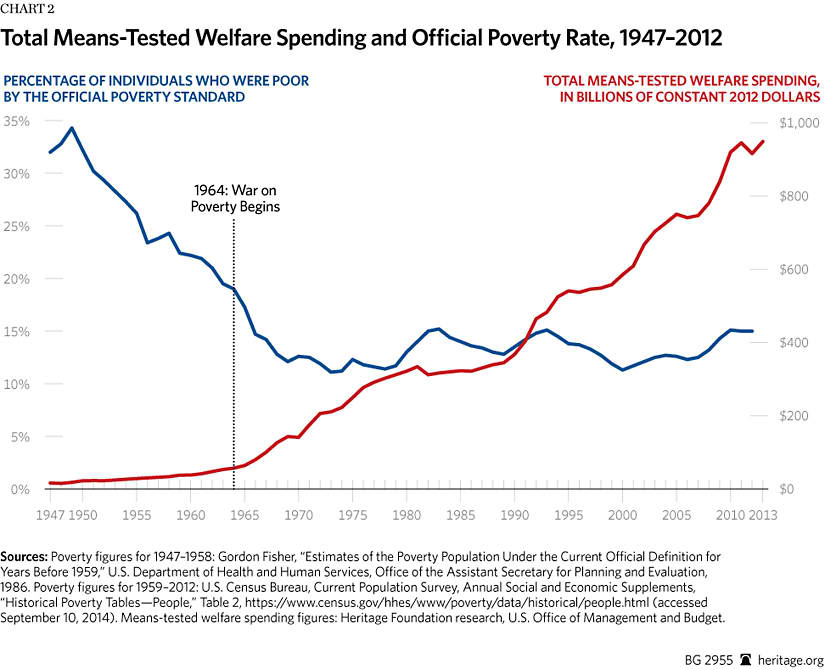
Next year the United States will commemorate the 60th anniversary of the War on Poverty, initiated by President Lyndon B. Johnson in 1964. The War’s programs initially started on a modest scale but have expanded almost parabolically since. At the 50th anniversary of the launch the government had spent more than $22 trillion on various welfare and redistribution programs and today spends $1 trillion a year on said programs… not including various “targeted” expenditures under Social Security or Medicare, which make the true total simply unknowable.  To put that in perspective, $1 trillion is greater than the GDP of 194 of the world’s 213 countries. 

Is this massive expenditure justified by the results of the War on Poverty? Initially one might suggest the results say yes. As of 2021, poverty in the United States hovered at approximately 11.6%, down from the approximately 18% rate in 1964 when the War on Poverty began. That’s a reduction of 6.6%, or almost one third. 


A closer look however reveals that that 6.6% reduction after an expenditure of $30 trillion seems underwhelming to say the least.  To see the full picture of the failed War on Poverty one need only look at the poverty rate over the 15 years prior to its beginning.  In 1949 the poverty rate in the United States stood at 34%, fully one third of the nation’s population.  Over the next 15 years, without significant government redistribution programs, indeed, without the War on Poverty, the poverty rate fell almost by half, falling from 34% to 18%, a reduction of a full 16 percentage points.  So, without government spending significant money poverty fell 16% in a period of 15 years, or 1.08% per year.  But with government spending more than $30 trillion over the next 55 years it fell by a total of just 6.4%, or .12% per year! That essentially means that without government intervention the poverty rate was falling 10 times faster than it did once government programs kicked in.       

And that 11.6% itself deserves a closer look.  In 2014, when the War on Poverty turned 50, the American poverty rate was still at 15%. That means that after spending $20 trillion over the previous half century the government had successfully reduced poverty by a mere 3%. When Barack Obama he entered the White House in 2008 the poverty rate stood at 12.5%.  It jumped up to 15% for four years before dropping back to 12.5% by the end of his presidency and where it was when Donald Trump took the White House. A mere three years later Trump’s economic renaissance had reduced poverty by 2%, bringing it to its lowest level in history, 10.5%, before the Covid scam derailed the prosperity engine. To put that in perspective, Donald Trump’s economy brought poverty down by 2% in 3 years, fully half as much as government spending did in the 53 years between 1964 and 2016.   

And of course the income numbers only tell part of the story.  Sadly, there is much more to it. 

An unintended consequence of the War on Poverty appears to have been a skyrocketing of single-parent households, which is a significant driver of poverty.  In 1964, around 4% of American children were born to unwed mothers. By 2021, this percentage increased a full ten times to 40%. Under the heading of Unintended Consequences one could observe that the welfare programs intended to save children from poverty, have, by making it economically and socially viable for single-parent households to exist, in fact stranded many children in poverty and worse, inflicting on them the coincident pathologies of poor education and crime, not coincidentally, both also being consequences of government failure.

From another perspective, let’s draw a comparison between the effects of government spending and the impact of private-sector investments. Let’s take just three companies, Apple, Amazon, and UPS who together had about $1 trillion in revenue in 2022, approximately the same amount the government spent on welfare that same year. These companies – and many others like them – revolutionized industries, drove many trillions of dollars of business for customers and vendors and affiliates; directly and indirectly employ millions of Americans who are breadwinners for their families, and at the same time generated trillions of dollars of wealth for investors.    

One can only wonder what might have happened if the more than $30 trillion the government wasted on its failed War on Poverty had instead been invested in startups similar to Apple and Amazon.  Not that we want the government taking our money and investing it – WE DON’T – but imagine the impact that money might have had had it somehow been targeted towards entrepreneurship and economic development. The 2% reduction in poverty during Trump’s first three years demonstrated with crystal clarity that market driven prosperity is a far more efficient vehicle for reducing poverty than government spending of any form. At a minimum, a market driven solution would likely have fostered a far more empowered, economically vibrant and dramatically more prosperous population than the generational dependency created by the government with its alphabet of aid programs. 

Benjamin Franklin understood this more clearly than virtually any politician in America today, having commented: “I am for doing good to the poor, but I differ in opinion of the means. I think the best way of doing good to the poor, is not making them easy in poverty, but leading or driving them out of it. In my youth I travelled much, and I observed in different countries, that the more public provisions were made for the poor, the less they provided for themselves, and of course became poorer. And, on the contrary, the less was done for them, the more they did for themselves, and became richer.”

Whether it’s student debt or the federal and state welfare perpetuation machines, America would be better off looking to the Founding Fathers for guidance than the grifters at either end of Pennsylvania Avenue…

Sunday, March 8, 2015

Barack Obama will go down in history as the most successful president since Abraham Lincoln...

The eight year reign of Barack Obama will go down as the most important in American history since Abraham Lincoln.  Lincoln led the United States at the single most important decision point in its history. At stake was no less than the question of whether the country would continue as a single nation or would it split in two as Manifest Destiny was fulfilled. Would there be a largely agrarian, slaveholding Confederate States of America bordering on a largely industrial and free United States of America or would a single, free and economically mixed United States emerge? At no point in the subsequent century and a half did the United States ever face a more foundational question.

Six years into Barack Obama’s presidency - and looking with much trepidation at the “last” two - one can’t help but wonder what kind of a nation will emerge on the other side. “History” said Winston Churchill, “is written by the victors” and like it or not, Barack Obama is the victor. Not sure about that? Take a look at the latest capitulation by his supposed opposition, Boehner and McConnell, the GOP leaders of the House and the Senate, respectively. In what is only the most recent example of obsequiousness they have vociferously attacked their own base in order to allow Obama to continue with his patently unconstitutional amnesty.

And what is it that Barack Obama has done to merit such distinction? He has opened the Pandora’s Box of unprecedented, omnipresent, government intervention. And like the evils escaping from Pandora’s Box, once government intervention is put in place you can’t get rid of it. With Obamacare he decreed that the government can tell Americans what they must buy, for their own good. With his NLRB appointees and the nationalization of General Motors he has eviscerated private property rights. With his using the IRS to muzzle opposition and his FCC taking over the Internet, he has taken a sledgehammer to concept of free speech and free markets.

In addition, his regulatory bonanza and welfare policies have cut the legs out from the basic premise of hard work being the key to success in America. By making entrepreneurship and job creation more difficult and by providing a seemingly endless array of benefits, he has driven the labor participation rate down to levels not seen in four decades.

And of course it’s not just the laws. He has set black against white as he constantly invokes racism in places where it simply doesn’t apply. What’s more, he has essentially told black Americans, those who are at most risk of being victims of crime, that the police are their enemies. He has set the poor and middle class against the rich as he assails the successful as robber barons who earned their success on the backs of others.

The country was far from perfect when Barack Obama took office and you can make the argument that it was already heading in a troubling direction when he came along. But the difference is, unlike Abraham Lincoln, who sought to save the Union, Barack Obama set out to fundamentally transform it. And that he has… from a place where individual initiative was the key to overcoming challenges, achieving success and finding happiness to a place where the first instinct of many is to look for someone to blame for their lack of success or happiness, or to try and figure out which arm of government to look to provide them.

Combine that entitlement / victim mentality with a legion of regulatory diktats and unconstitutional decrees – that no one in power seems willing to fight – and you have a recipe for a banana republic where power is held by whoever bribes the largest number of people and creates scapegoats to fuel populist furor. And so it goes as a nation of giants transforms into a nation of beggars and a government limited by the Constitution becomes a one limited only by a president’s appetite.

No president in 150 years has changed America more. Not Roosevelt, not Kennedy, not FDR not Reagan. Such is the transformation Barack Obama promised and delivered. Most Americans won’t view it as success, but the left does. Therefore, if history is indeed written by the victor – or in this case by his lefty sycophants in the media – Barack Obama will go down as the most successful president since Abraham Lincoln. And at this point it might be useful to think of something Churchill’s enemy, Adolph Hitler, said: “If you tell a big enough lie and tell it frequently enough, it will be believed.”

Monday, August 6, 2012

Mitt Romney should leverage his tax records to re-educate Americans on the prosperity capitalism can engender.

For months we’ve heard calls from Democrats for Mitt Romney to release his tax records. Last week Harry Reid even claimed he had it from “a number of people” had told him that Mitt Romney had not paid his taxes for a decade and demanded he release them.

I’d like to suggest Mitt Romney actually go ahead and release his tax records. Much like pulling a Band-Aid off a wound, where the fear of the pain is actually worse than the pain itself, I suspect the speculative hay that Democrats will be making over the next three months will be a far more attention grabbing than the actual returns themselves would be.

This is not to suggest that Romney should feel compelled to provide whatever information Democrats seek. On the contrary. I’m suggesting that Romney use his tax returns to do something he has yet to forcefully do: Make a crystal clear argument that capitalism is at the core of American success and it offers virtually every American the opportunity to achieve prosperity. Essentially his argument should be something like: “I’m proud to have earned hundreds of millions of dollars throughout my career. I’ve paid tens of millions of dollars in taxes, I’ve donated tens of millions more to charities and I’ve helped create tens of thousands of jobs and I’ve helped generate billions of dollars in honest income for tens of thousands of American families.”

Such language, when coupled with a telling of his time at Bain demonstrating the impact he and Bain had on companies from Staples, to Gartner Group to Domino's Pizza clearly tell the story of success that capitalism has written in our past and can write for our future.

Staples provides a perfect example. Bain Capital was one of the key early funders of the company in 1986. Not only did Staples itself create over 50,000 jobs within its stores, but it likely created hundreds of thousands more by giving small business people the opportunity to save money on office products, which they could then invest in other areas of their businesses such as marketing, capital and even employees. At the end of the day Bain Capital and Mitt Romney may have made tens of millions of dollars from their Staples investment, but the positive impact on the economy was worth billions.

But of course not all Bain endeavors worked out, and in some cases both money and jobs were lost. But that’s the whole point of capitalism. Mitt Romney’s job at Bain Capital was never to create jobs, nor to destroy them. It was to employ the capital in his care in such a way that it would legally earn the most money possible for his investors. Bain’s capital was simply one – albeit an important one – of the inputs necessary to build, grow or rescue a business. Others include everything from risk taking to janitorial services to manufacturing to R&D and hundreds more. Capitalism works because it harnesses the efforts of millions of producers, each seeking to achieve their own goals to meet the needs of millions or billions of consumers seeking an ever evolving supply of goods and services.

There may be no better demonstration of the power of the mechanism of capitalism than Leonard Read’s seminal 1958 essay “I, Pencil”. Read demonstrates with unparalleled clarity the myriad forces that come into play in order to manufacture one simple pencil. From the lumberjacks in California and Oregon to the graphite miners in Sri Lanka to the workers shipping the pumice from Italy, everyone plays a role in the manufacturing of the pencil, not by adhering to some grand top-down strategy for manufacturing a pencil, but rather by doing what they have chosen to do in response to the needs of the market.

The lessons Read wrote about in I, Pencil are as true today as they were in 1958. Compare the market driven success of the mobile device universe with the iPhone, Google’s Android, Amazon’s Kindle and their hundreds of thousands of apps with the abject failure of government driven endeavors such as solar power, ethanol, education and General Motors.

Mitt Romney should leverage his tax returns and the wealth they reflect to champion the cause of capitalism and clearly demonstrate the role it plays in American prosperity. Indeed he could not have asked for a better foil than Barack Obama in an effort to contrast that success with the abject failure of the progressive top-down statist approach. It’s not often that history gives a politician the opportunity to dovetail their personal story with current events to demonstrate with crystal clarity the superior nature of capitalism vs. statism. By releasing his tax returns and explaining the story behind them Romney will not only take a weapon out of the hands of his opponents, but more importantly, he can remind many Americans that it was capitalism that allowed us to prosper in the first place.

Tuesday, May 29, 2012

Three Cheers for Wealth Inequality

One can’t but hear the almost daily drumbeat from the left about how unequal things are in the United States. There is an income disparity between the haves and the have-nots where Wall Street bankers take millions of dollars home to their Greenwich mansions while millions of others work for minimum wage and can’t afford their own home, never mind something resembling a mini-Versailles.

That may be true, but the reality is, inequality exists today, inequality has always existed, and inequality will always exist. Why? Because people are simply different. People have different motivations, different skillsets, different temperaments, different passions, different work ethics… essentially, everyone is different. As such, why does it make sense that everyone would be equal? It doesn’t.

It doesn’t matter if it’s at work or at school or volunteering for a church fundraiser, different people perform differently. In school I remember friends who earned straight A’s with seemingly little or no effort while I struggled to get Bs or Cs. Of course, even though I recognized how challenged I was, I rarely did the work I knew was necessary to merit anything other than a passing grade. I always told myself that I could have earned straight A’s had I applied myself. Maybe I was right, maybe I was wrong, but the reality is that I didn’t care enough about earning A’s to do the work to earn them.

And so it goes in life. Most people get out of it what they put into it. The United States is a nation where, for the most part, people have the opportunity to achieve the success they seek if only they work hard enough and smart enough to get it.

No nation of any size has ever created an environment where everyone was equal in outcomes. Lots have tied however from Revolutionary France to the Soviet Union to Communist China. Economic equality has been tried on our shores as well, from the Mayflower Compact to New York’s Oneida Community to the 1960s communes. All failed to achieve anything resembling a sustainable equality and are gone, other than Communist China, which is anything but egalitarian in any sense of the word.

Today in the United States it’s fashionable for union activists and college students to protest the inequality in society where the rich get richer and the rest of us get poorer. The problem with that logic is that while the rich have gotten richer, so has everyone else. Does it matter if the rich are 25 times richer than the poor if everyone is twice as well off as they used to be? Poverty used to mean that someone had little if any food and possibly a ramshackle place to live if they were lucky enough to have a roof over their head at all. Today, poverty in America means something quite different… Refrigerators, air conditioners, televisions, DVD players and cell phones.

Indeed, in America today poor people have far more in common with rich people than perhaps any point in human history. In 15th Century the King of France had hundreds of courtiers whose jobs were to do everything from cook his food, put his clothes on him to literally wiping his behind when he was done with his business. Paupers not only could never afford the King’s luxury, they didn’t have access to the same basic amenities in life from nutrition to leisure time to entertainment. The discrepancy was not something that could ordinarily be erased by hard work or ingenuity. In this respect Royal France was not so different than most periods of human history. Similar disparities existed in Cleopatra’s Egypt, Victorian England and Tsarist Russia as well.

In America however, not only are those listed in poverty far better off than at any time in human history – and indeed better off than many middle class Europeans today – they also have opportunities for upward mobility that have rarely existed anywhere at any time.

Given that we all have unique DNA, we all live unique lives, we are all motivated by and drawn to different things, economic equality and prosperity tend to be mutually exclusive. As William Bradford learned, imposing equality of outcome leads to economic ruin.

Luckily for Americans and the rest of the world, the United States learned early that a society that seeks to be truly egalitarian doesn’t start by declaring everyone share everything they have or that somehow citizens were to become robots where everyone produced the same amount and consumed the same amount. No, the Founding Fathers delivered something far more powerful. They created a nation where everyone (eventually) was able to harness their unique abilities to invent, innovate and simply work to create a better life for themselves and their families. In doing so the United States has led the march of the improvement in the condition of man over the last two centuries.

With that improvement came great disparities. At one point after the turn of the century when the average American was earning $750 per year, John D. Rockefeller’s wealth was $1 billion, or about 1.5% of US GDP. (For comparison, an equivalent net worth today would be approximately $210 billion, four times Bill Gates’ wealth.) Despite the wealth disparity, the average American was far better off because of Rockefeller as energy prices declined by more than 90% between 1865 and 1910 even while demand skyrocketed. The average American benefited from similar disparities with giants like Carnegie, Vanderbilt and continue today with men like Bill Gates and Jeff Bezos.

The proof is definitive; capitalism makes people richer, both the capitalists themselves and everyone else. As such, the question for the left is: Is their goal to make the lives’ of everyone better or simply destroy the capitalists? Their actions seem to suggest the latter, but if their true goal is the former, they should throw down their “I am the 99%” banners and storm Washington. Not to demand the heads and wallets of the rich, but rather to inveigh against Congress for creating a bureaucracy that hinders a citizens ability to harness their passions, skills and ingenuity to earn themselves millions of dollars as they enrich consumers willing to pay for whatever goods or services they provide.

It’s no coincidence that six of the ten richest men in human history are Americans, three of whom started their lives as paupers. We should celebrate their wealth and success as we benefit from their efforts. Perhaps such celebration would inspire millions of would-be entrepreneurs, inventors and innovators to follow their examples. We should be so lucky.

Monday, July 25, 2011

The Debt Ceiling and the Democrat's Xbox War on Poverty

The debt ceiling talks fell apart on Friday as President Obama insisted on $400 billion in new taxes to pay for more government spending. Imagine if he didn’t have to spend those $400 billion over the next decade.

Is it possible that there is $400 billion of waste in the budget somewhere? Where might that be? How about amongst the impoverished?

What do most Americans think of when they think of the word poverty? Homeless is likely at the top of the list. Lack of adequate or any food is probably not far behind. Not enough money to have heat in the winter might be another. Lack of medical care. There are no doubt others, but those likely the things most Americans think of when they think of the poor. And that’s not by accident.

According to the U.S. Census Bureau, 30 million Americans are living in poverty. That number has remained largely stable for decades. When the nightly news reports that fact and couples it with pictures of people sleeping on grates around the National Mall or a woman and her children huddled in a homeless shelter, most people with a heart feel like there must be a problem if such poverty can exist within the borders of the richest country on the planet? Unfortunately however that is base manipulation.

The Heritage Foundation recently reviewed a variety of government data and found a picture much different than what the left would like you to believe. They reviewed data from the Census Bureau, the agency that defines how many people are living in poverty, and the Department of Energy, that produces a survey looking at what amenities people have. Looking at the poor through DOE data paints a slightly different picture than what the media paints with Census Bureau data.

According to DOE data, 99.6% of poor households have a refrigerator, 97.7% have at least one TV, 97.7% have a stove & oven, 81% have a microwave, 78% have air conditioning (vs 84% for the general population) 64% have a DVD player, 63% have cable or satellite, 54% have a cell phone (vs 76%) 29% have a video game system (such as Xxox or Wii) (vs. 31%). Forty-three percent of all poor households own their own homes and the average poor American has 16% more living space per capita than the average person living in France, Germany, the UK or Japan. While households with such amenities may be considered poor, they can hardly be considered to be living in poverty in the clearest sense of the word.

The goal here is not to diminish the notion of poverty in America. Indeed there certainly exists poverty in the true sense of the word: According to the US Department of Housing and Urban Development a person classified as living in poverty had a 1 in 25 chance of spending at least one night in a homeless shelter during 2009 vs. 1 in 195 for the average American. And there really are families that end up in homeless shelters with no other place to go. At the end of the day, statistics are statistics but life is life. If you are one of the people who are living in a homeless shelter or on the street or hasn’t had anything to eat or can’t find a safe bathroom, it doesn’t matter what the average square footage a European gets by with is. What matters to you is what is going on at that exact moment.

And that’s where the problem as defined by progressives and Democrats comes in. By defining poverty so broadly they do a disservice to the truly poor. How? By perpetuating programs that send resources to those do not need them. Every time a taxpayer stands in line at the grocery store and watches a welfare recipient talk on her cell phone and pay cash for cigarettes and lottery tickets while using food stamps to pay for food it diminishes support for all government programs. It also keeps dollars from those programs which target the truly needy.

Rather than having programs that could help those with significant problems, we have welfare programs that simply perpetuate more welfare. Between 1965 & 2008 the United States spent $15.9 Trillion in its War on Poverty (vs $6.4 on all real wars) yet 10% of the population is considered to be living in poverty today.

Despite the War on Poverty’s abject failure, it goes on. And here’s where it hurts. Even now amidst the toughest economic environment in half a century, with urban unemployment in the double digits, when the government has to borrow a trillion dollars to pay its bills President Obama and the Democrats continue to play politics. When the GOP seeks to reduce government by cutting wasteful programs, the left accuses them of wanting to cut the safety net out from under America’s most vulnerable. That’s John Edwards lie of Two America’s all over again, and it’s still a lie.

The DOE’s numbers clearly demonstrate that there is a distinct difference between those considered poor and those in need of real help. While the most effective strategy would most certainly be to eliminate all government welfare programs and allow private charities to take over, that is unlikely to get by a donkey led Senate or the progressive in the White House. More realistically, by painting an accurate picture of poverty in the country, Uncle Sam could more precisely tailor programs to help the truly needy. Doing so would help those in need by being more effective, it might help restore the American taxpayer’s opinion of government in general and would save hundreds of billions of dollars just at the time when America finds itself broke.