Showing posts with label waste. Show all posts

Friday, February 7, 2025

Can a Nation Built By Giants Survive the Disability Industrial Complex?

Vivek Ramaswamy got himself in some hot water a couple of weeks ago when he tweeted about American culture. He’s wrong on the big picture, but his comments about American workers hits a nerve… 

While the US Constitution and free market capitalism set the foundations for American prosperity, it took a rugged, passionate, free people to build it. From George Washington to George Washington Carver to millions of other Americans, the United States was carved out a continent of forests that seemed to go on forever, fertile plains, vast mountain ranges and scorching hot deserts.  Over time American frontiersmen, settlers and entrepreneurs forged a country that seemed to have all of God’s blessings in abundance.

Conditions were rarely easy for most Americans throughout most of our history. Coal miners spent 12 – 16 hour shifts in dangerous mines in which they sometimes couldn’t even stand up. Frontiersmen built a homestead and a farm out of a thick Appalachian forest while fighting brutal winters and a tenacious Indian population. Slaves toiled for years at backbreaking work during freezing winters and boiling summers. At the end of the 19th century over 50% of Americans still lived and worked as farmers, a far more dangerous job than most people understand. The industrial revolution brought sweatshops and drove a thirst for steel, trains and petroleum, industries that brought new dangers.

One sometimes has to marvel that the colonies survived long enough to coalesce and challenge the British for independence and then go on to grow and prosper (mostly) for over 200 years as it changed the world.

Were the Americans who carved a nation out of a continent somehow so different than Americans today? Were the Americans who crisscrossed a continent with railroads, telephone lines and highways so different than Americans today? Were the Americans who won two world wars and sent a man to the moon so different than Americans today? Were the Americans who invented the mechanical reaper, air conditioning, vulcanized rubber and the microchip so different than Americans today? Not based on DNA they weren’t. But that doesn’t mean they were the same. While the DNA of the American people today is no different than that of the people who invented the elevator or the light bulb, the American people writ large certainly appear to be.

Go back little more than one generation and it seems like Americans were something of another species. Compared to 2025, they appear to be relative supermen. In 1970 there were 79 million people working in the United States supporting 1.5 million workers on Disability Insurance (SSDI). That means that one person out of every 52 workers was on Disability… Fast forward 5 decades and it seems as if the country has turned on its side. By 2024 the number of Americans working had risen by 100% to 161 million people. During that same period however, workers receiving disability insurance skyrocketed up 380% to 7.2 million. Today, instead of one out of every 53 workers being on disability, it’s one in 22! That number is particularly interesting because the United States of 1970 was a far grittier place than the United States of 2025.

First off, the United States in 2025 is a much different workplace than the one that existed in 1970. In 1970 fully 25% of the American workforce worked in manufacturing while 50% worked in the service industry. Today, 8% of the American workforce works in manufacturing while over 70% of workers work in the service industry. Given that designing a website, taking an order at Chili’s or greeting a guest at Marriott is generally less dangerous than welding together various pieces of a Ford Ranger or operating a blast furnace at a US Steel plant, America should be a safer place to work. And indeed it is. The death rate for American workers in 1970 was 18 per every 100,000 workers. By 2023 that rate had dropped to 3.5, a decline of 80%.

But of course work is not the only place where one gets hurt. Today, virtually everywhere Americans go everything seems safer. Cars have seatbelts, antilock breaks and airbags. Houses have GFCI circuit breakers in bathrooms and kitchens and smoke detectors in almost every room. Lawn darts are but a distant memory and towns across the country require helmets for bicycle riding and virtually every appliance and medicine comes plastered with book length warning label. At the end of the day, America has become a far safer place to live and work than it has been at any time in its history.

But somehow in that much safer America, the total of people listed as disabled and receiving disability payments has skyrocketed:  The government spends more on disability than on food stamps and welfare combined.  American workers paid .5% of their paychecks for SSDI when it began 70 years ago, but in 2022 they paid 2%.  That means that $2 out of every $100 an American worker earns goes to support someone not working.

How is that even possible? Have Americans become weaklings, unable to stay healthy? Has some unknown affliction made us incapable of working? No. There is an affliction, but it’s not biological. It’s called the nanny state. From judges who rubberstamp virtually every claim they ever see to a quarter of applicants suffering from musculoskeletal injuries – which conveniently enough cannot be detected by doctors – to outright fraud (more)(more)(more) and states seeking to shift costs to the federal government, SSDI is a symbol of much of what is wrong in America today, where in 2022 fully 4.5% of working age Americans were on disability. The worst thing about this dysfunctional program is that the fraud keeps people who are in real need of help waiting in line, sometimes to die.

When government decides to play the role of caretaker and redistribute wealth from workers to everyone else, it should come as no surprise that many people will choose to jump from the working pool to the everyone else pool. For more proof just look at the food stamp program over the same 50 year period. While the population has increased by about 75% since 1970, workers by 100% and disability by 380%, food stamp recipients grew by over 1,000%!

The economics of the welfare state, including the “disability industrial complex” cannot be sustained. If the record of the last 50 years were to be repeated over the next 50, in 2075 the country would have 320 million workers supporting almost 30 million people on disability and 450 million people on food stamps. Those numbers are simply unsustainable, particularly if the goal is to Make America Great Again.

American workers and entrepreneurs have together created the greatest wealth and prosperity the world has ever seen, but eventually the numbers stop working.  The thing I think Ramaswamy misses is that it was inevitable that the spirit that helped forge a nation out of a continent and dot it with jewels like the Empire State Building, the Hoover Dam and the Golden Gate Bridge would reemerge and shrug. That’s what happened in November. For it to make any difference however, the nanny state will have to be eviscerated, and not just the regulatory part of it. 
The redistribution apparatus will have to be dismantled too, and the disability industrial complex is a good place to start. 

Monday, August 7, 2023

Not news - nor a surprise: The Government Lost the War on Poverty

Recently the Supreme Court put an end to Joe Biden’s efforts to gift erstwhile college students almost a trillion dollars in “debt relief”.  That’s a lot of money… but in reality that’s a tiny fraction of the money the government has wasted on redistribution, AKA social programs over the last six decades.

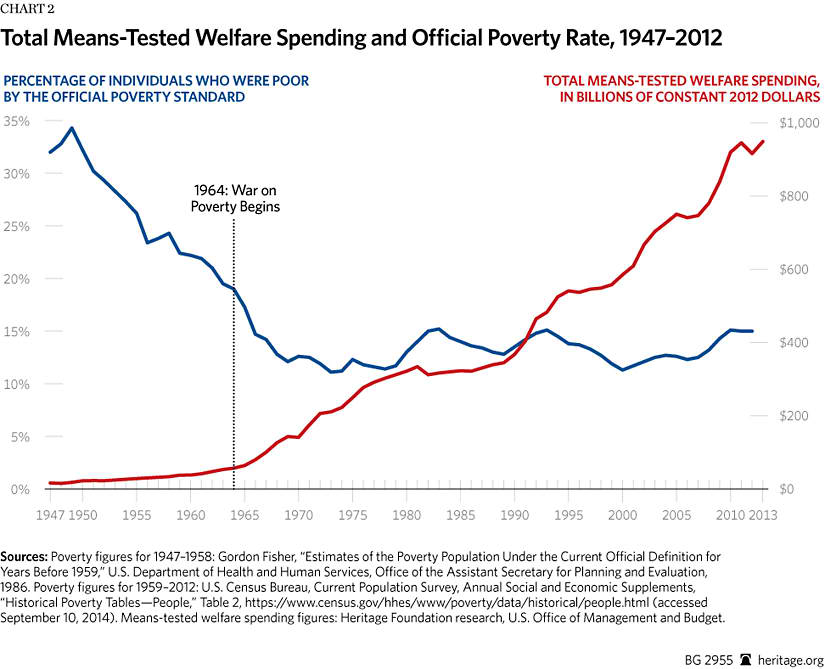
Next year the United States will commemorate the 60th anniversary of the War on Poverty, initiated by President Lyndon B. Johnson in 1964. The War’s programs initially started on a modest scale but have expanded almost parabolically since. At the 50th anniversary of the launch the government had spent more than $22 trillion on various welfare and redistribution programs and today spends $1 trillion a year on said programs… not including various “targeted” expenditures under Social Security or Medicare, which make the true total simply unknowable.  To put that in perspective, $1 trillion is greater than the GDP of 194 of the world’s 213 countries. 

Is this massive expenditure justified by the results of the War on Poverty? Initially one might suggest the results say yes. As of 2021, poverty in the United States hovered at approximately 11.6%, down from the approximately 18% rate in 1964 when the War on Poverty began. That’s a reduction of 6.6%, or almost one third. 


A closer look however reveals that that 6.6% reduction after an expenditure of $30 trillion seems underwhelming to say the least.  To see the full picture of the failed War on Poverty one need only look at the poverty rate over the 15 years prior to its beginning.  In 1949 the poverty rate in the United States stood at 34%, fully one third of the nation’s population.  Over the next 15 years, without significant government redistribution programs, indeed, without the War on Poverty, the poverty rate fell almost by half, falling from 34% to 18%, a reduction of a full 16 percentage points.  So, without government spending significant money poverty fell 16% in a period of 15 years, or 1.08% per year.  But with government spending more than $30 trillion over the next 55 years it fell by a total of just 6.4%, or .12% per year! That essentially means that without government intervention the poverty rate was falling 10 times faster than it did once government programs kicked in.       

And that 11.6% itself deserves a closer look.  In 2014, when the War on Poverty turned 50, the American poverty rate was still at 15%. That means that after spending $20 trillion over the previous half century the government had successfully reduced poverty by a mere 3%. When Barack Obama he entered the White House in 2008 the poverty rate stood at 12.5%.  It jumped up to 15% for four years before dropping back to 12.5% by the end of his presidency and where it was when Donald Trump took the White House. A mere three years later Trump’s economic renaissance had reduced poverty by 2%, bringing it to its lowest level in history, 10.5%, before the Covid scam derailed the prosperity engine. To put that in perspective, Donald Trump’s economy brought poverty down by 2% in 3 years, fully half as much as government spending did in the 53 years between 1964 and 2016.   

And of course the income numbers only tell part of the story.  Sadly, there is much more to it. 

An unintended consequence of the War on Poverty appears to have been a skyrocketing of single-parent households, which is a significant driver of poverty.  In 1964, around 4% of American children were born to unwed mothers. By 2021, this percentage increased a full ten times to 40%. Under the heading of Unintended Consequences one could observe that the welfare programs intended to save children from poverty, have, by making it economically and socially viable for single-parent households to exist, in fact stranded many children in poverty and worse, inflicting on them the coincident pathologies of poor education and crime, not coincidentally, both also being consequences of government failure.

From another perspective, let’s draw a comparison between the effects of government spending and the impact of private-sector investments. Let’s take just three companies, Apple, Amazon, and UPS who together had about $1 trillion in revenue in 2022, approximately the same amount the government spent on welfare that same year. These companies – and many others like them – revolutionized industries, drove many trillions of dollars of business for customers and vendors and affiliates; directly and indirectly employ millions of Americans who are breadwinners for their families, and at the same time generated trillions of dollars of wealth for investors.    

One can only wonder what might have happened if the more than $30 trillion the government wasted on its failed War on Poverty had instead been invested in startups similar to Apple and Amazon.  Not that we want the government taking our money and investing it – WE DON’T – but imagine the impact that money might have had had it somehow been targeted towards entrepreneurship and economic development. The 2% reduction in poverty during Trump’s first three years demonstrated with crystal clarity that market driven prosperity is a far more efficient vehicle for reducing poverty than government spending of any form. At a minimum, a market driven solution would likely have fostered a far more empowered, economically vibrant and dramatically more prosperous population than the generational dependency created by the government with its alphabet of aid programs. 

Benjamin Franklin understood this more clearly than virtually any politician in America today, having commented: “I am for doing good to the poor, but I differ in opinion of the means. I think the best way of doing good to the poor, is not making them easy in poverty, but leading or driving them out of it. In my youth I travelled much, and I observed in different countries, that the more public provisions were made for the poor, the less they provided for themselves, and of course became poorer. And, on the contrary, the less was done for them, the more they did for themselves, and became richer.”

Whether it’s student debt or the federal and state welfare perpetuation machines, America would be better off looking to the Founding Fathers for guidance than the grifters at either end of Pennsylvania Avenue…

Monday, October 3, 2011

At least when a pirate takes your money, you know its going to create real jobs in the rum industry...

How much do you earn per year? $25,000? $75,000? How about $150,000? Maybe a bit more, maybe a bit less. Whatever you earn, you probably wish your check was just a little bit bigger.

Many of us look at guys like Alex Rodriguez earning $30 million a year or Johnny Depp earning $50 million or Larry Ellison earning $130 million and wish we could exchange paychecks with them. But then of course we’d have to do what they do in exchange for those paychecks, something which most of us are unlikely to be able to accomplish. That is of course the beauty of free markets, where what you earn is relative to not just the value you bring to an organization, but the relative scarcity of potential replacements who can provide that same value. Take as an example a fireman. Firemen do things that everyone values. When you are standing there and your house is burning down, you value what a fireman does more than anything Angelina Jolie, Bill Gates or Dr. Dre will ever do. Let’s say the average fireman makes $45,000 a year in salary and benefits. Does Johnny Depp’s $50 million compensation mean that his job is 1,000 times more important than the fireman’s? No. The difference is that while Johnny Depp is one of only a handful of actors who can almost guarantee to make a $150 million movie into a blockbuster, there are tens of thousands of people who can and will train to become firemen. Although Hollywood is full of actors who might be willing play the role of Jack Sparrow, the discount DVD bin at Wal-Mart demonstrates clearly why Disney was willing to pay Depp tens of millions of dollars to reprise his role.

In a free market, as what someone earns is largely determined by the value they bring to whoever is writing the check, and how many other people can provide that same value, people can do a variety of things to increase their income by increasing the value they bring to their employer. They can get more or a better education. They can train at their craft to become more skilled. They can learn more skills so they can bring value in other areas.

Wherever your skills, education and efforts have landed you, you probably feel like you work pretty hard and earn your paycheck. Now imagine on having a job paying $95,000? That sounds pretty good. Now imagine that in exchange for that $95,000 you don’t have to actually do anything. Well that was the case with Solyndra. Not that the employees weren’t working hard and trying to create a successful company, they very well might have been. The problem is that the business they were in was simply not sustainable. As is seemingly always the case with “green jobs” everywhere, they can’t survive even the most basic elements of a competitive marketplace. Of course if an investor wants to put their money there, that’s their right. Invest in something you think has legs. Maybe you’re right, maybe you’re wrong. Give it a shot. That’s how free market capitalism works.

Unfortunately however, that’s not what happened at Solyndra. The Obama Administration decided that American taxpayers should tip the scales by putting up half a billion dollars for a company that spent $6 to manufacture a solar panel that it could then turn around and sell for $3. A four year old would recognize that was a recipe for disaster. Even a few people in the Administration saw that there might be a problem. Not only did they know it was problematic before they gave the guarantees, but they had to bend the rules half way through to let the company take all of the money guaranteed even after Solyndra failed to make it’s required payments.

Just in case you think the Administration was chastened and might have learned from its mistakes, think again. Just last week the DOE handed out another $5 billion in loan guarantees to other “green jobs” companies – one of whom is owned by Nancy Pelosi’s brother in law. In the case of one of those projects, the Crescent Dunes Solar Energy Project, the Obama Administration officials signed off on $737 million in loan guarantees for a project that will result in 600 construction jobs and 45 permanent jobs. That works out to $1.245 million per temporary job or $16,600,000 per permanent job. Those numbers are getting up into the Matt Damon pay range. Of course that’s not what those workers are going to be paid, but if Solyndra is anything to go by, they will be earning $100,000 or so per year. Good for them. I’m happy to see anyone earn whatever they can earn. The problem is, however, that the companies paying their salaries are not viable entities. They can’t survive without government support. And government support doesn’t come out of thin air. It comes out of your pocket in the form of taxes. Imagine if the government weren’t wasting these billions of dollars… your $75,000 paycheck might look like $80,000. Who would you rather have that extra $5,000 per year, you and your family or the people running the next failing “green jobs” basket case?

If the American people want to spend $5 billion investing in the future, I’d suggest they follow the path laid out by PayPal founder Peter Thiel rather than the one crafted by community organizer Barack Obama – i.e. more taxes and more money to floundering green companies. Thiel is paying a handful of students $100,000 to drop out of college and spend two years becoming entrepreneurs. They get a guaranteed paycheck, they get mentoring from Thiel and others in the venture capital world, but most importantly, they spend their time seeking to create, invent and develop technologies or products or services that will change the world.

To put this is perspective, the typical VC investment scenario plays out as follows: They lose money on seven out of ten investments. They break even on two out of ten. One of the ten is sufficiently successful that it not only pays back everything that was invested in it, but it covers the losses of the seven and makes money on the whole project.

If that kind of an approach were applied to the money the DOE is throwing down the “green jobs” ratholes, at least we’d have a chance to recoup our money and maybe find a technology that could actually survive in the marketplace… Of course the best thing to do would be to get the government out of the “investing” business all together, and let you keep your money. That $5 billion giveaway to the greenies works out to about $16 per person. If you had it back you might be able to go and see the latest Johnny Depp movie and help the studio pay his hefty salary. You might even have enough left over for a bucket of popcorn.

Tuesday, August 23, 2011

Conservatives want SMALL government, not NO government...

Conservatives are constantly being accused of wanting no government. When we talk about wanting to eliminate things like the IRS, the Departments of Energy and Education or rein in rouge agencies like the EPA and the NLRB we are accused of wanting no government at all. That’s simply false. I don’t think I’ve ever heard a conservative speak about wanting to eliminate all government, or even the federal government.

Most conservatives understand that the absence of functional government brings chaos. In an environment where chaos reigns, at some point someone will step in and impose order. That person or group then becomes the de facto government. Perhaps the clearest example of this in recent history was the Taliban takeover of Afghanistan in the mid 1990’s. Although pockets of resistance remained, by the late 90’s the Taliban were firmly in control of the country. Most Afghanis didn’t like the Taliban, but they appreciated the relative order they brought to the country.

Here in America our problem is not a lack of government, but the opposite, too much of it. The strings of regulation end up wrapped around the wheels of the American economy and ends up clogging what might otherwise be a well oiled machine. An unfettered economy would not be flawless, but it would be far more dynamic than the straitjacketed one we have today.

To put this in perspective, take the IRS tax code. According to the Heritage Foundation, it will cost America just more than $400 billion in 2011 to comply with the tax code, and that does not include the cost of the actual taxes themselves. Given that the federal government will take in approximately $2.2 trillion in taxes this year, that means Americans will spend an additional 20% of their tax bill just trying to figure out how to pay the bill in the first place!

How is that even possible? Well, the tax code is approximately 72,000 pages long and it’s broken down into 750 subchapters. Imagine if you are a widget manufacturer with 10,000 employees spread out over 20 states. How many employees would you need to have on staff to make sure that that company was complying with the regulations written on every one of those 72,000 pages? How much time (read: money) would your accounting and legal staffs have to spend to ensure that everything you did was within the IRS’s guidelines? How much time would management have to waste evaluating what product or service to provide or what energy provider to choose depending on what provides the best tax advantage? How about deciding how employee benefits should be allotted between taxable and non-taxable to maximize employee compensation?

As difficult as scenario is, at least large companies can pay for the necessary accounting and legal staffs. Imagine you are a struggling businessman with 5 employees who has to choose between spending money on another employee to help him compete in the marketplace or on someone to decipher the 72,000 pages of the IRS tax code. The fact that an employer (or homeowner or parents of a college student or someone approaching retirement…) has to base many of their financial decisions on what the IRS rules are is bad enough, but for the rules to be so numerous and incomprehensible that it restricts productivity borders on criminal. And to put a cherry on top of it, all of that effort is spent just to figure out how to give the money to the government so they can spend much of it on stuff you'd never pay for if you had the choice.

Lucky for Americans, the tax code is not the only sign of a government gone wild. There is also the Code of Federal Regulations (the codification of the general and permanent rules published in the Federal Register by the executive departments and agencies of the Federal Government). The Code covers 163,333 pages, in 226 books. Those are the regulations that cover everything from that ticket on your mattress to the kind of gas you can put in your car to how long an airline can delay a flight to what can be labeled diet in the supermarket to the endless pages of directions and warnings provided with medicine bottles. Unless you are living in Ted Kaczynski’s summer home, not a day goes by that you do not cross paths with hundreds or thousands of these regulations. Like microwaves, you may not see them, but they are there nonetheless, impacting everything from hiring (or not, as the case might be) or marketing or investment decisions for everyone from Fortune 500 companies to neighborhood entrepreneurs.

The Competitive Enterprise Institute estimates that federal regulations cost Americans $1.75 trillion each year. That includes everything from environmental regulations to cable rates to the number of hours employees can work to months of tax compliance research. Add to that the $2.2 trillion Uncle Sam collects in taxes and you have almost 25% of our GDP being directly driven by government. Given the suffocatingly large and restrictive presence of government in our lives, is it any wonder that our economy is moving along at a dying snail’s pace? How many life saving medicines, technological breakthroughs, or even things as simple as more comfortable shoes have not been realized because we waste so much time and money focusing on regulation and compliance? At the end of the day conservatives don’t propose no government, just limited Constitutional government. We’d like to free up the American people to transform this moribund economy into a juggernaut of creativity, productivity, jobs and prosperity. That can’t be done while they are being strangled by government rules and regulations…